
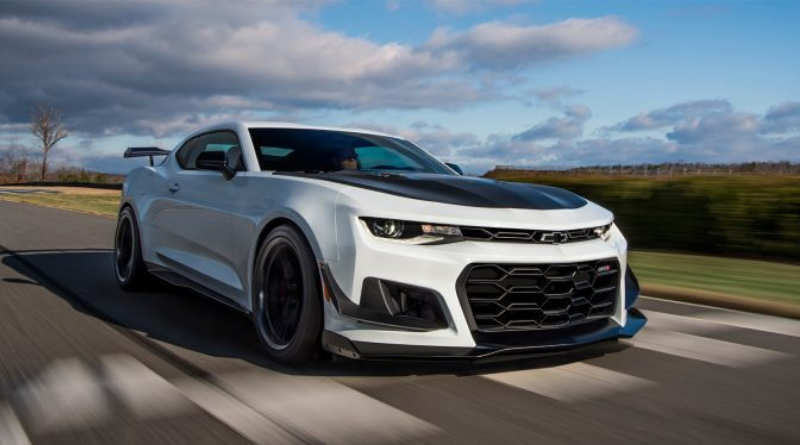
Auto Industry News: Chevy Discontinuing Camaro, Ford Cutting Jobs in Europe, While FCA Announces a Widebody Dodge Charger Redesign
Detroit’s Big Three are keeping busy this week. As the bowtie badge preps for the new Corvette’s debut, is Chevy discontinuing the Camaro … again? Another American muscle contender fares better, as FCA announced a widebody Dodge Charger redesign is in the works for 2020. Meanwhile, Ford cuts 12,000 jobs in Europe as it stays the course of its $11 billion EV restructuring plan. Plus, some unexpected Formula 1 finishes and a big weekend for NASCAR.
Chevy Discontinuing Camaro … Again?
Multiple sources within GM have told Muscle Cars & Trucks that the next generation Chevy Camaro development program has been suspended, likely signaling a shelf period for the nameplate after 2023.
At current, the sixth generation Camaro sits on the dynamic Alpha platform shared by the Cadillac ATS and CTS. Both of those models are set to be replaced by the CT4 and CT5, respectively, using an updated version of the Alpha platform called the A2XX. However, sources say that while all three models will be built at the same assembly plant, there are no plans to transition the iconic Chevy to the new platform. Current production plans do not extend past 2023.

This isn’t the first time Chevy has discontinued the Camaro. The nameplate has gone on hiatus before, most recently in 2002. Camaro fans were left without a new version of the iconic muscle car until 2006 when Chevy revamped the Camaro name as a concept car that eventually became the extremely popular fifth generation offering in 2009.
Numbers Don’t Lie
One peek at the Camaro’s sales numbers, and Chevy’s actions begin to make a little more sense. Deliveries are down 25% from last year, with just under 51,000 totaled for 2018. And according to GM Authority, “Chevy still has unsold 2018 model year vehicles on dealer lots, even though the 2019 Camaro refresh has already arrived, and the 2020 Camaro will get a few updates and changes along with a new LT1 trim level.”
That spells heavy price reductions and consumer rebates to push old product off the lots.
Pair these declining sales numbers with fans’ hostile response to the 2019 model’s design refresh, and a recycled Camaro program team as GM shifts its best and brightest to leaner and greener vehicles, and perhaps the Camaro’s struggles aren’t that much of a surprise.

Typical to GM, the company is keeping mum. When asked about Chevy discontinuing the Camaro, a spokesperson told Motor1 that they would not “engage in speculation,” and would rather “remind you of our recently announced updates coming to the Camaro lineup this fall,” including an all-new LT1 model and new front fascia for the SS.
Despite the uncertainty Chevy may be facing regarding the Camaro, excitement for the new mid-engine Corvette is reaching a fever pitch. After months of speculation, the official release date of July 18 is fast approaching for the next-gen ‘Vette. Expected to sport a 6.2-liter pushrod V-8 making 500 horsepower, Chevy claims this is “the most anticipated Corvette ever.”
Our Engine Block contributor, Brian Stone, will be digging into this coverage further as more details become available.
Ford Cutting Jobs in Europe Amid Stricter Regulations
In an effort to return to profitability overseas, Ford is cutting 12,000 European jobs from plants in England, Wales, France, and Russia. The cuts, which will include roughly 2,000 salaried positions and impact over 20 percent of the automaker’s European workforce, are set to go into effect by the end of the year.
Ford has struggled for years in the European market, with circumstances growing more stressful in the wake of Brexit and ever-tightening emission standards. Additionally, the overall demand for cars in Europe is falling, with experts predicting stagnation or decline in the next three years.
While passenger vehicles are clearly headed toward an electric future, automakers need to walk a difficult tightrope—pouring financial resources into R&D, retooling existing facilities, redesigning flagship models, and establishing a viable charging network, all while phasing out internal combustion engines AND turning a profit. Simply put, they have their work cut out for them.

Not to mention, there’s a steep cost to not meeting those strict emissions standards. According to Bloomberg, the industry faces penalties in excess of $39 billion dollars, as it is ill-equipped to keep up with the EU’s newest round of stiffer CO2 targets.
Unfortunately, the technology needed to make the necessary changes to emissions systems is not always economically viable. If automakers can’t reach these new standards, they’ll do what they can—which is cut jobs, slash production, or leave the market completely.
It’s Not All Doom & Gloom
While Ford cutting jobs is never good news, the company’s restructuring efforts should bring new opportunities with them—including potential new jobs. Since announcing back in January that job cuts were on the horizon, the Blue Oval formed an alliance with Volkswagen to build up its EV portfolio. According to the New York Times, Ford announced that, “all its new models would have options for electrification and that it would be building electric vehicles in Europe.”
Dodge Charger Redesign Set For 2020
While one American muscle car seems to be on its last legs, the Dodge Charger, at least, is getting a face lift. Fiat Chrysler claims the new 2020 Charger Hellcat Widebody will be the “most powerful and fastest mass-produced sedan in the world,” capable of reaching 60 mph in 3.6 seconds and maxing out at 196 mph top speed.

The car will feature a 6.2-liter supercharged HEMI V8 engine, rated at 707 hp and 650 pound-feet of torque, with an 8-speed automatic transmission as standard. The wide-body design includes massive fender flares that add 3.5 inches of width over the 20×11-inch wheels and new front and rear fascias, including a redesigned dual-snorkel grille. Stopping power comes compliments of six-piston Brembo brakes with two-piece rotors, while a new Hellcat-specific, retuned suspension system with Bilstein shocks keeps handling in check.
Mopar Insiders reports that in addition to the SRT Hellcat, there will be an R/T Scat Pack version of the widebody Dodge Charger Redesign as well, wearing the 6.4-liter HEMI V8 and making 485 hp and 475 lb.-ft. of torque.
No word yet on pricing but deliveries are expected to start early next year.
Around the Circuit
Formula 1
Max Verstappen won the Austrian Grand Prix for the second year running, handing team Mercedes their first loss of the season so far.
Verstappen overtook Ferrari’s Charles Leclerc with only two laps remaining, running him off the road after a dramatic dive inside, prompting an investigation that ultimately confirmed his victory three hours after the race ended.
On the incident with Leclerc, he said: “It’s hard racing or we have to stay home. If those things are not allowed in racing then we have to stay home.”
Rounding out the Top 5 was Charles Leclerc in second, Valtteri Bottas in third, Sebastian Vettel in fourth, and Lewis Hamilton in fifth.
Next up for F1 is the Rolex British Grand Prix from July 12 to 14.
NASCAR
Monster Energy Series
Alex Bowman won his first career Monster Energy Series race this weekend at Chicagoland Speedway, holding off Kyle Larson by .546 seconds and reigning cup champ Joey Logano in third. The two young drivers were neck-and-neck going into the final laps, swapping the lead eight times over the last eight laps.
Battling rain showers that delayed the race nearly three hours and outdueling his opponents, Bowman was thrilled after the race. After finishing as a runner up three times in his first 16 races, he finally won.
“It’s all I’ve wanted my whole life,’’ Bowman said after climbing down off his car’s roof. “I’m just tired of running second, didn’t want to do that anymore.’’
Next up for the Monster Energy Series in the Coke 400 at Daytona International Speedway on July 6.
Xfinity Series
Cole Custer finished ahead of Joey Logano and Michael Annett for his fourth win of the season.
Custer had the upper hand for the majority of the race, only losing the lead briefly a few times before surging back ahead. This is Custer’s second win in the last four weeks, finishing second during his last race at Iowa.
“I think we’re going to hit it this summer, we have some awesome cars,’’ Custer excitedly told the front grandstands. “I don’t know how to get the car any better, I’m just lucky to drive it.’’
The Xfinity Series’ next race is the Circle K Firecracker 250, scheduled Friday, July 5 at 7:30 p.m at Daytona International Speedway.
Gander Outdoors Truck Series
Brett Moffitt finished a comfortable 3.950 seconds ahead of Brandon Jones to win the Gander Mountain Outdoors Truck Series Camping World 225 this weekend.
The reigning series champ earned his second win of the season in convincing fashion, a much different scene than his surprise win two weeks ago at Iowa Speedway due to a Ross Chastain disqualification.
The next race takes place July 11 at 7:30pm at the Kentucky Speedway.


