
Auto Industry News: Mint 400 Wraps, ID. Buzz Debuts, Hellcat Loses Manual, & Rivian Gets Sued
The slow slide to an electric-driven future continues to pick up speed. Automakers pumped more EVs into the pipeline this week, while the current state of affairs makes it harder to pump affordable fuel into your tank. However, despite some interesting new rides (like VW’s updated take on the hippie bus), as well as the continual disappearance of manual transmissions (lookin’ at you, Dodge), the road to mainstream EVs is beginning to show come cracks. Case in point? The first EV startup since Tesla to show any really ability of standing on its own two feet – Rivian – faces yet more problems, including painful Q4 revenue losses, a freshly-inked lawsuit, and a lot of angry rural Georgians.
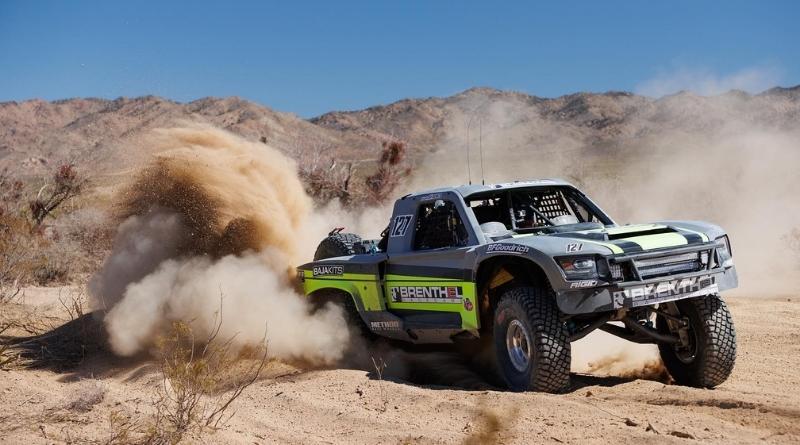
But first… high-performance V8 powertrains proved their popularity this past weekend at the Mint 400. The race returned to its regularly-scheduled March placement on the calendar, and served up a thrilling multi-day celebration of desert racing.
Mint 400 Recap
The Mint 400 returned to the Nevada desert this past weekend, delivering several days of sand-in-your-teeth excitement. Festivities began with an off-road festival and parade on Wednesday and Thursday, giving fans an opportunity to get up close and personal with their favorite drivers. This year’s roster was impressive, too, with big names both in and out of the sport. In addition to off-road superstars like Rob MacCachren, Kevin Thompson, Ryan Arciero, and Loren Healy, more surprising athletes made an appearance too, like Olympic gymnast Shawn Johnson and her NFL husband, Andrew East, as well as NASCAR star Hailie Deegan and Le Mans winner Davy Jones.
Staging and qualifying began Friday, with three-time champ Justin Lofton posting the top qualifying time at a blistering 3:59.349 – more than two seconds faster than any other competitor in the Unlimited Truck class. Second place qualifier was Harley Letner, with a time of 4:01.770. Qualifying third was 2021 Mint 400 runner-up, Ryan Arciero, who edged out last year’s champ Rob MacCachren by just under three tenths of a second. Completing the top five was Dale Dondel, just 9.3 seconds off the top spot.

Unlimited class qualifying ran simultaneously with the O’Reilly Auto Parts Limited Race. That event saw Pro UTV Turbo driver Dustin Jones take home his second Mint 400 victory in as many years. He and co-pilot Dustin Henderson enjoyed a margin of victory more than 21 minutes over second place finisher Randy Romo.
RACE DAY
Saturday served up a full plate of racing, with motorcycles leading the charge.
Motorcycle Race
Immensely popular since its return just a few short years ago, the 2022 Mint 400 Motorcycle Race served up an eclectic mix of racers and bikes. Ultimately, it was Dalton Shirey who took victory – for the second time in three years. He teamed with David Kamo, who he beat for the Mint win just two years ago. The two men dominated the six-lap, 60-plus-mile course, completing in 7:53:50, a butt-kicking 43 minutes and 50 seconds ahead of second-place finisher Jesse Canepa and 47:19 ahead of third-place Brock Weisheim.
Youth Race
The future of the sport was also on display, with several youth races taking place. Notably, Landen De Sousa Dias took the checkered flag in the five-lap Youth 1000, scoring a victory of more than a minute over Ryan Bedoya with a time of 34:24.303. De Sousa Dias was elevated to the winning position after a seven-minute penalty to Jedi Jack Mamelli for multiple unintentional course cuts.

Unlimited
As for the main event, Lofton led the field into the desert from Primm. However, both him and second-place qualifier Harley Letner ended up pulling off track while many other competitors were still waiting to leave the line. It was third qualifier Ryan Arciero who spent a majority of the race firmly in the top spot of the Unlimited Truck standings, until a mechanical failure ended his run out on the dry lake bed on the third lap. Last year’s winner Rob MacCachren then took the lead, but he too eventually pulled off the course with mechanical troubles.
That’s when the patience of KOH Desert Challenge and BITD Trick Truck champ Kyle Jergensen paid off. He assumed the lead and held on tight, outlasting the other racers despite oil pressure issues with his own truck. This is Jergensen’s first Mint 400 victory, which he sealed with a winning time of 6:43:49. A scant 3:19 behind him was Tim Herbst, while Las Vegas native and 2011 Mint 400 winner BJ Baldwin rounded out the podium with a time of 6:51:09.
Industry Scuttlebutt
Despite the current bedlam as it pertains to supply chains, gas prices, and global political harmony, many automakers are staying as close as they can to product release schedules… while others are just trying to stay alive.
Buzz Debuts – But Not For U.S. (Yet)
After a half-decade of teasing, Volkswagen finally revealed the production version of its 21st century, all-electric Microbus. The modern minibus, dubbed ID Buzz, looks significantly more grown-up than its beloved hippie ancestor, bearing that same middle-aged color palette one sees slapped on renovated McDonald’s across America.

There’s no denying some cool stuff is happening here – cutting-edge technology, an all-electric drivetrain with bidirectional charging, a bevy of recycled materials in the cabin. But it’s a little hard to agree with VW’s assessment of this ride as a “joy-o-meter” bearing an “inner fun compass.” (Whether that’s because modern “counterculture” has become more informed or simply takes itself too seriously is up to you.)
Enough busting on poor Buzz; here’s what you need to know:
- The production version wears a similar square body, though with a more aerodynamic haircut. According to VW, the ID Buzz has the drag coefficient of a car.
- Underneath that body is VW’s MEB platform, which also underpins the ID 4 crossover. The two models also share an 82-kWh lithium-ion battery pack and rear-mounted permanent-magnet motor pumping out 201 hp and 229 lb-ft of torque.
- The debut model appeared in standard-wheelbase form destined for the European market. The U.S. version, set to arrive in 2023, will (supposedly) be a long-wheelbase configuration. This bigger Buzz is expected to get a 300-hp twin motor version and larger battery package in order to come closer to a 300-mile range target.
- Using the latest ID software, the model line will also eventually offer a ‘Plug & Charge’ function. With this tech, Buzz authenticates itself at compatible charging stations and exchanges payment for you.
- Bidirectional charging enables the ID Buzz to feed unneeded energy from the battery into the customer’s home network (Vehicle-to-Home).
- Inside, you’ll find a lot of recycled materials, as well as animal-free upholstery. Tech-wise, a 10-inch digital gauge cluster, 10-inch infotainment screen, and wireless charging functionality come as standard equipment.
- Standard-wheelbase models will be available in two-, three-, five-, and six-passenger configurations, complements of a front bench seat. The American version will be a seven-seater in a 2/3/2 arrangement.

Hellcat’s Missing Manual
It appears those itching to buy a manual transmission version of the Challenger Hellcat will be out of luck for the 2022 model year. Dodge insists this is a temporary measure, noting the required Powertrain Control Module (PCM) needed a new calibration. A December Road & Track forum post alleges the manual transmission cannot pass emissions when paired with the Hellcat’s 6.2-liter supercharged Hemi V-8, implying the type of calibration necessary.
A Growing Trend
Regardless of why Dodge iced the stick shift and when it may or may not return, dropped manuals are becoming more commonplace – and noticeably among sportscar brands. Ferrari abandoned the manual transmission in 2016, while Lamborghini ditched it two years earlier. Aston Martin announced plans to start phasing out the option with the 2022 refresh of the Vantage. Even among the more democratically-priced options, the new C8 Corvette marks the first generation of the Corvette that is automatic-only.
There are a few reasons for this, chief among them being simple market demand. As more drivers migrated to the comfortable and easier-to-operate automatic transmission, manuals began to plummet in popularity. In 2019, manual transmission vehicles accounted for a mere 1.1% of all new-vehicle sales in the U.S. EVs actually took a bigger cut of the pie at 1.6%.
For the 2021 model year, Cars.com notes that excluding high-end exotics, only 36 nameplates offered a manual — a clear minority of the 300-plus models on sale overall. (Fun fact: Subaru has more nameplates with three pedals than any other brand.)
“The quantitative argument for a stick shift is not even a conversation at this point, in terms of the numbers,” John Paolo Canton, spokesman for McLaren in North America, told Bloomberg News in a 2016 report on the decline of manuals. (For reference, McLaren has never offered a stick shift in any of its cars since debuting the first road version in 2010.) “It’s just so much faster, it’s not even close. It’s more fuel efficient, and it produces fewer emissions.”
Not Gone Yet…
That said, it’s not yet time to lament the feature’s passing. Just this week, Road & Track reported that whispers of a manual transmission in the Toyota Supra have moved beyond rumors thanks to the loud criticism of die-hard fans. The information came via alleged official documentation on the car posted to image-sharing platform Imgur.
Rivian’s Bad Day Lingers On
Things continue to look… not great …for young electric-vehicle manufacturer, Rivian. On top of last week’s drama, the automaker released its Q4 2021 earnings, confirming a $2.4 billion loss. (It is down $4.7 billion for the full year.) Rivian also revised its initial 2022 production target of 50,000 vehicles down to 25,000 – despite having about 83,000 reservations on the order books. The company also confirmed it produced only 1,410 vehicles thus far in 2022, barely more than it did in all of 2021.
For some perspective: The amount of money Rivian lost in one quarter of 2021 is a little more than Tesla lost in all of 2017. However, Tesla delivered more than 102,000 vehicles that year, breaking its 100,000-target goal.
Rivian blames supply chain shortages and bottlenecks, as well as the skyrocketing price of nickel, a key element in the manufacture of batteries. The almighty shareholders continue to express their discontent by dropping stock like a hot potato. The company is now trading at a valuation of roughly $35 billion, a far cry from its eyebrow-raising $100 billion valuation back in December – which was more than established automakers like GM and Ford.

Legal Drama
Adding insult to injury, the automaker was slapped with a lawsuit last week by a shareholder who alleges the company made “untrue statements” in its IPO about the pricing of its R1T truck and R1S SUV. The suit is in response to Rivian’s unexpected 20-percent-hike in vehicle pricing shortly after its IPO.
This drama comes on the heels of other legal trouble, including a November lawsuit from former sales and marketing exec Laura Schwab who said Rivian’s “toxic bro culture” excluded her and other female execs from a circle of men around the CEO, effectively preventing her from doing her job. It’s worth noting that buried deep within those court filings (filed last year – long before the price hike) are some particularly damning statements from Schwab. She details how she tried several times to raise the alarm with other executives that the vehicle pricing was unrealistically low and would need to be raised. She alleges she was told to keep quiet until after the IPO. If that directive is proven true, Rivian could land in some seriously hot water with the SEC.
Additionally, last July, Tesla filed a legal complaint alleging that Rivian misappropriated “Tesla’s trade secret[s], confidential and proprietary information by recruiting Tesla employees and encouraging them to take such information as they leave Tesla.”
With all that uncertainty, it’s no surprise Rivian is having trouble convincing rural Georgians to allow a $5 billion factory in their backyard. You can read up on that drama here and here.
Aftermarket Update: DECKED Acquires CargoGlide
Mergers and acquisitions are becoming a trend in the automotive aftermarket, but this one feels like a good match. DECKED, which makes heavy-duty deck and drawer storage systems for full-size pickup trucks recently acquired CargoGlide, an industry-leading sliding truck bed accessory manufacturer. DECKED GM, Jake Peters, called the move “a natural acquisition” saying CargoGlide’s “ergonomic focus is a great complement to DECKED.”
The CargoGlide line will be fully integrated with DECKED’s own Drawer System and Tool Box products, the company said. It will eventually be offered via DECKED’s website.

The Engine Block is your one-stop source for any and all auto industry news. Keep an eye on our weekly round-up of enthusiast coverage, product reviews, vehicle spotlights, auto show/expo features, and more. With the weather warming up, be sure to check back Friday for our comprehensive Off-Road Checklist. From vehicle maintenance to recovery gear, we cover the gamut.


