
Auto Industry News: Monthly & Quarterly Auto Sales, Incoming & Outgoing Vehicle Models, Musk & Twitter Drama, and What’s Up With EV Tax Credits?
Second-quarter sales results are in, alongside June numbers from those automakers who still report monthly tallies. The verdict? Consumer sales activity is still a bit of a mixed bag, as demand remains high but low supply is driving up wait times, purchase prices, and interest rates. We break down the good, the bad, and the head-scratching for you in this week’s round-up.
Plus, catch up on Elon Musk’s ongoing tango with Twitter, which took an interesting turn last week, and learn more about the popular vehicle models sitting on automakers’ chopping blocks. As you can guess, a lot of EVs stand in the wings as replacements, begging the question: What is going on with these EV tax credits? The Engine Block explains the most recent debate around the issue and why no one can seem to agree on a solution.
June and Q2 Sales Results

Total June new-vehicle sales rang in at 1.13 million, which is a slight increase over May’s 1.11 million total but still a 13.5% decline from this time last year. The same issues persist – namely, parts (and people) shortages, and limited inventories. However, rising vehicle costs, interest rates, and insurance rates are also taking their toll on consumer sales activity.
Looking at the entire second quarter (which includes combined sales totals from April, May, and June), new-vehicle total sales landed around 3.4 million units. That’s about a 20.5% decrease from the same period last year, according to J.D. Power and LMC Automotive. As a result, the companies updated their yearly total estimate of new-vehicle sales to be about 13.1 million units, down 2.3 million units from 2021.
Zooming in on the individual automakers, a few interesting things caught our eye…
… GM reclaimed the sales crown it lost to Toyota last year, even though its second quarter sales dropped 15% year-over-year. Interestingly, of all GM brands, Buick was hit the worst – sliding a painful 56% in Q2 – despite recently taking top honors in J.D. Power’s Initial Quality Study.
… Ford squeaked by with a 1.8% increase in overall Q2 sales, but racked up a 31.5% gain for the month of June. Likewise, the Lincoln division enjoyed a 41% increase in June, ending a full year of monthly sales declines. The Aviator, Corsair, and redesigned Navigator SUVs helped end the brand’s dry spell.

… Detroit’s third resident automaker, Stellantis, saw its Q2 sales drop 16%. In fact, nearly every brand under the corporate umbrella suffered double-digit declines for the three-month period, save for one. Chrysler – yes, Chrysler – posted a whopping sales increase of 95%. It’s thought a backlog of fleet orders for the Pacifica drove those numbers skyward.
… Hyundai’s luxury brand Genesis saw its June sales jump 11%, marking the 19th straight month of increases. Genesis was also one of the few brands to post a noticeable Q2 increase (25.9%).
… Despite a 54% slide for June and 50% decline for Q2 (ouch), Honda is still enjoying turn rates of up to 90% for its core products – a clear sign that consumer demand remains strong but supply is a major issue.
… Tesla’s numbers also reflected supply issues. While the automaker produced more cars in June 2022 than any previous month in its history, deliveries still dropped 18% compared to the previous quarter. However, the company still produced and delivered more vehicles than it did in Q2 last year.
Elon Musk, Twitter and… the Pope?
Perhaps the only thing stranger than Elon Musk taking a break from Twitter is his returning to the platform with a photo of him alongside Pope Francis. Granted, it’s not entirely unusual for the pontiff to meet with auto executives. (He does need popemobiles when he travels around the world, after all.) However, no reason for this particular audience with His Holiness was provided.
Honored to meet @Pontifex yesterday pic.twitter.com/sLZY8mAQtd
— Elon Musk (@elonmusk) July 2, 2022
According to AP News, Pope Francis often meets with “high-profile figures” and urges them to use their wealth and technology to help the poor. Still, talk about a strong opening tweet after 10 days of radio silence!
Perhaps Musk was seeking guidance on his proposed $44 billion Twitter purchase… which he decided to terminate last week.
While the Tesla CEO cited material breach of multiple parts of the agreement, the main sticking point in the deal seems to revolve around spam bots. Twitter claims less than 5% of accounts are fake, but Musk is skeptical and insists the company cannot provide adequate proof of its claims. Now, he faces a potential $1 billion termination fee and legal action from Twitter’s board for threatening to pull the plug. Is he serious or just attempting to negotiate a lower purchase price? Time will tell.
What’s Going on with EV Tax Credits?
You may have heard that Toyota is now the most recent automaker to phase out of the federal EV tax credit. The company passed the 200,000-vehicle threshold last month, triggering a reduced credit that will lessen by half every six months, until it is completely exhausted. Tesla was the first EV-maker to pass this mark, back in July 2018, with GM joining the club shortly after in April 2019.
What’s interesting for Toyota is that it reaches the cap at a somewhat inconvenient time. The automaker just began rolling out its all-new battery-electric vehicle, the bZ4x, which it co-developed with Subaru. This means that Toyota customers cannot cash in on the $7,500 federal incentive, but Subaru customers still can – giving the second automaker a leg up, since its Solterra is basically a twin to the bZ4x.

While the Toyota-Subaru situation is unique, they are not the only two automakers offsetting EV-building costs through collaboration — meaning, we could see a similar scenario play out again. And, indeed, EV tax credits have been a thorny issue for several years now. Let’s unpack a few of the reasons why.
Proposed changes run the gamut.
When the initial tax credit took effect in 2009, its goal was to drum up interest for electric technology. Lawmakers figured as more EVs hit the mainstream, the vehicles would become more commercially affordable. As a result, the credit would eventually become unnecessary – hence the phaseout terms.
It’s not a bad plan. However, that scenario hasn’t played out yet. In fact, EVs remain (mostly) an expensive option for car buyers. And even with the rising number of new models on the menu, the electric market as a whole remains largely niche with American car owners.
While legislators have attempted to amend the tax credit to better reflect this current state of affairs, they can’t seem to agree on a direction. One proposal which sought to reduce the credit by $500, but extend the vehicle cap to 600,000 was shot down by Congress in 2019. Then, late last year, the House passed more aggressive Build Back Better legislation which aimed to increase the consumer tax credit, raising it from $7,500 to as much as $12,500, and tack on an extra $4,500 if the vehicle in question was made with domestic union labor. The bill also would extend the credits for a full decade.
No one can agree on anything.
The most recent plan received vehement push-back from non-union automakers like Tesla, Toyota, and Honda, who felt they would be unfairly penalized despite the fact they still employ American workers at U.S.-based plants. The proposal also drew ire from Canada, whose finance and trade ministers threatened to file a dispute settlement under the USMCA trade deal and institute retaliatory tariffs. They too had a problem with the union provision, arguing it was unfair and would hurt the entire North American auto industry.

Most importantly, though, the tax credit plan failed to win the support of Joe Manchin, a West Virginia Democrat and key swing vote in the evenly-split Senate. “When we can’t produce enough product for the people that want it and we’re still going to pay them to take it — it’s absolutely ludicrous in my mind,” he said.
That’s not to say Manchin is completely against a credit.
Last August, he and two other Democrats voted with GOP lawmakers for a non-binding budget amendment that would restrict the EV tax credit to individuals making less than $100,000 and for vehicles that cost less than $40,000, Forbes reports. Why? Well, a common criticism of the entire EV tax credit program is that it unfairly favors the wealthy.
Many electric vehicles still boast exclusionary price tags, and a person can’t claim the refund until the end of the year (meaning they have to front the purchase price). Additionally, the credits are nonrefundable. That means, the credit can only offset taxes owed — and it cannot bring them below zero. Essentially, a person would need to make about $65,000 a year in order to owe enough tax at year’s end to qualify for the full refund. More than 1/3 of Americans make less than $50k annually.
So, where does this leave us?
“At this point, what we are left with is the base credit,” said Joe Britton, head of the Zero Emission Transportation Association, a federal coalition focused on advocating for 100% EV sales by 2030. However, Britton said conversations were still ongoing, specifically as it pertains to lifting the 200,000-vehicle cap.
With EV market share only around 4.6% in America, and three automakers already past the credit threshold (with Nissan and Ford knocking at the door), it’s a safe bet some changes to the EV tax credit will make it through Congress this year.

Coming & Going
According to the Bank of America Merrill Lynch annual Car Wars study, automakers will launch about 245 new models over the next four years. If that number seems high, that’s because it is – about 50% higher than the average pace set over the last two decades. Consumers are looking at about 61 new models per year, says the study’s author John Murphy, who expects the majority to be either electric or hybrid.
Below are a few future rides seen spied around town.
Extended, Next-Gen Ford Ranger
Set to debut in 2023, the next-gen Ford Ranger will feature an extended wheelbase variant. Recent spy photographs show the midsize pickup driving around Dearborn, Michigan with a truck bed that appears to be longer than the current model’s 5-footer. While the photographed Ranger wears camouflage, we have a pretty good idea already of how the truck will look. Ford unveiled the global version in November 2021, along with general stats that we expect to carry over. However, it appears the North American market – where big trucks are a staple – will potentially receive a SuperCrew option with a 6-foot bed.
Another Ranger variant set to hit North American shores in 2023 will arrive in the form of a Raptor. Ford CEO Jim Farley confirmed the news via tweet back in February.

Chevy Silverado EV
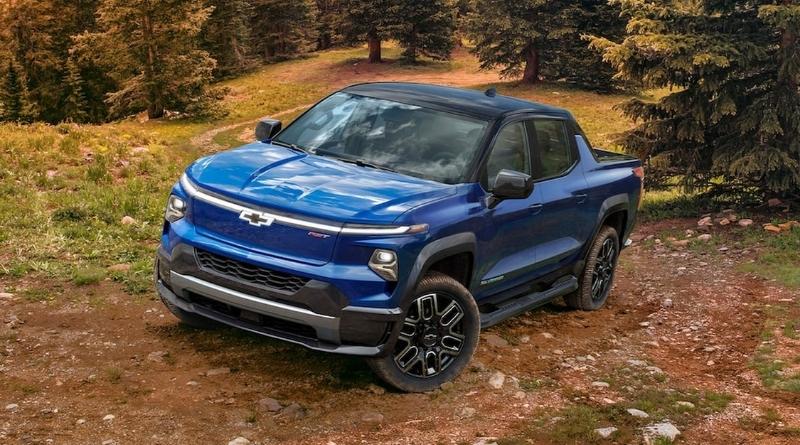
Full-size pickups are king in this country, so it’s not terribly surprising that automakers are eyeing up the segment for their EV agendas. Chevy announced it was electrifying the Silverado at CES 2022 – news that helped GM’s stock hit record high values at the time.
Chevy already released renderings of the new Silverado EV, but last week the automaker shared some sneak peeks of the truck testing at the company’s proving grounds in Milford, Michigan. Mary Barra noted via tweet that the truck will start testing on Detroit streets next month.
Engineered from the ground up with a dedicated Ultium BEV platform, the 2024 Chevy Silverado EV promises to be a powerful contender in the EV truck space. GM says it will offer up to 400 miles of range, 664 horsepower, and 10,000 pounds’ worth of tow rating depending on the trim. Prices will range anywhere from $40,000-$100,000 depending on how loaded the model is.
Spotted – a @Chevrolet Silverado #EV being put through its paces at the @GM Milford Proving Ground. Looking forward to seeing your photos of these trucks in the wild when they start testing on Detroit streets next month! pic.twitter.com/AUJRcmmXoY
— Mary Barra (@mtbarra) June 30, 2022
Hyundai Electric Hot Hatch
The Hyundai Ioniq 5 is a quirky all-electric hatchback that is still only available in very limited quantities at select dealers in select states. However, that hasn’t stopped the automaker from sending the model through the Hyundai N performance division to develop a hot hatch prototype.
A spy video shows the new vehicle decked out in heavy camouflage, testing at the Nürburgring. Featured upgrades appear to include a lowered suspension, wider front and rear tracks, low-profile tires, bigger brakes with larger calipers and rotors, and a new wheel design. The hot model is expected to share performance characteristics with the Kia EV6 GT, which offers a dual-motor setup pumping out a whopping 577 ponies and 3.5-second 0-60 time.

Chopping Block
Hyundai giveth, and Hyundai taketh. Apparently these fast and flashy EVs come at a price, and in this case that means three models must leave the lineup. According to Automotive News, the Korean automaker will cut the Accent subcompact sedan, the Veloster N hatchback and both the hybrid and plug-in hybrid variants of the Ioniq compact car for the 2023 model year.
While not confirmed, there are also rumors that the Nissan Titan will not get another generation, and may in fact even be pulled from the full-size pickup market as early as 2024 or 2025. Compared to trucks from Detroit’s Big Three, the Titan simply has not attracted a significant following. Even after a major refresh in 2020, the vehicle couldn’t make much of a dent in the other manufacturer’s sales. By cutting the Titan, Nissan presumably could focus its efforts, resources, and production capacity on other profitable models and new EVs.

The Engine Block is your one-stop source for any and all auto industry news. Keep an eye on our weekly round-up of enthusiast coverage, product reviews, vehicle spotlights, auto show/expo features, and more. Be sure to check back Friday for a spicy opinion piece on electric vehicles — and the ICE innovations giving them a run for their money.


