
Auto Industry News: NHRA Four-Wide Firsts, Right to Repair Gets Federal Nod, Big Tech Wants to Charge for Self-Driving, and Several New EVs Hit the Market
The Federal Trade Commission seemingly threw some heft behind Right to Repair this week, issuing a report that pokes several holes in manufacturers’ justifications for restricting consumer repair options. Score one for enthusiasts! At the same time, Big Tech is seeking permits in San Francisco to begin charging for self-driving taxi rides. Here’s hoping the rise of autonomous shuttles doesn’t cancel out the human desire for mo’ powah…
The covers came off several new EVs this week, as well, with more brands finding ways to adapt their lineups. We break down a few that caught our eye.
But first, this past weekend’s NGK NTK NHRA Four-Wide Nationals at zMAX Dragway in Charlotte served up a few familiar champions, a first-time winner, and another first-in-a-long-time winner.
NHRA Four-Wide Nationals: Familiars & Firsts
Funny Car
The legendary John Force drove his way back into the winner’s circle, scoring his second four-wide victory in just his fourth race after a yearlong shutdown. Force outran fellow former world champions J.R. Todd and Cruz Pedregon, as well as Alexis DeJoria, to secure victory in his Danny Hood-tuned BlueDef Chevy Camaro. As the sport’s winningest driver, this marks Force’s 152nd career win. It also nicely complements his victory at the inaugural NHRA Four-Wide Nationals at zMAX Dragway back in 2010.

Top Fuel
Three-time and reigning champ Steve Torrence nabbed his sixth win in the last seven four-wide events, driving his Capco Contractors machine to a final-round victory over Brittany Force, Antron Brown, and Josh Hart. Despite the winning record, Torrence admitted he was not a fan of the four-wide at first. Six wally trophies will change a man’s tune, though, with the Top Fuel master saying he now loves the event and respects the challenge it presents.
Pro Stock
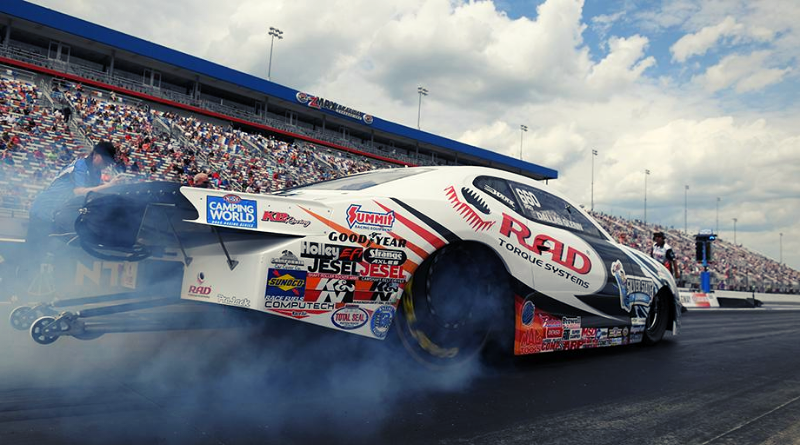
Promising Pro Stock rookie, Dallas Glenn secured his first career win this weekend, going 6.540-seconds at 209.88 mph in his Rad Torque Systems Chevrolet Camaro. Glenn held off fellow young guns Mason McGaha and Troy Coughlin Jr., with just .01 of a second separating the three drivers in the final round.
Pro Stock Motorcycle
Veteran Steve Johnson celebrated his first win in seven long years – setting a new track record to boot. Johnson not only made the third-quickest run in class history in the final round with a pass of 6.729-seconds at 198.03 mph, but he also lowered the quickest run ever for a Suzuki.
Johnson called the victory his “most special,” noting the “real validation” was just having the opportunity to compete with his crew chief Jock Allen. Allen spent 24 days on a ventilator last year after contracting COVID-19.
For a full list of the weekend’s winners, click here.
Right to Repair Gets Some Federal Muscle
The drama surrounding manufacturers and third-party repair services is not new. From cell phones to farm equipment, the tug-of-war over access to repair data drags on.
In the past year, the “Right to Repair” movement gained significant momentum, largely thanks to bipartisan support among lawmakers. (The pandemic, in particular, threw manufacturers into an uncomfortable spotlight, when it became painfully clear just how difficult it is for hospitals to repair their own life-saving medical equipment.)
Right-to-repair rules require companies to make their parts, tools, and information available to consumers and third-party repair shops, in an effort to keep devices, vehicles, and products out of the landfill.
Spurred on by consumer frustration, the House advanced a funding bill last summer that required the FTC to complete a report on anticompetitive practices in the repair market. The findings were to be presented to Congress and the public.
Well, folks, that report wrapped up this past week – and, judging by the cliff notes, things are looking up for everyday consumers.
A Familiar Dance to Gearheads
The report, cleverly dubbed “Nixing the Fix,” examines a variety of repair restrictions, but zeros in on those practiced by mobile phone and vehicle manufacturers. “Many consumer products have become harder to fix and maintain,” the FTC points out. “Repairs today often require specialized tools, difficult-to-obtain parts, and access to proprietary diagnostic software.”
The commission says it is ready to work with legislators to “ensure consumers have choices when they need to repair products that they purchase or own,” which implies some new rules and regulations may be in the pipeline. More importantly, however, the FTC calls for better enforcement of existing legislation – namely, the Magnuson-Moss Warranty Act (MMWA).

Auto enthusiasts reading this are likely familiar with this legislation, as it is what allows you to enjoy the deep growl of MagnaFlow exhaust system or the aggressive style upgrades of a Fab Fours custom bumper without voiding your vehicle’s warranty.
The FTC’s interest in the MMWA lies in the legislation’s anti-tying provision. Essentially, the little bit of wording that prevents, say, an automaker from voiding your warranty if you decide to get maintenance done by your local mechanic rather than the dealer.
While the commission already enforces violations of this provision, new technology is complicating efforts. Manufacturers claim that providing repair shops access to their diagnostic software will violate intellectual property rights or potentially open them up to cyberattacks. They also claim safety risks in letting an independent repair shop crack open a device and replace failed parts.
The FTC ain’t hearing it.
“There is scant evidence to support manufacturers’ justifications for repair restrictions,” the report states, concluding that the majority of these explanations “are not supported by the record.”
So, what does it all mean?
Well, not only could we see some loosening restrictions – we might just see them on a national level, across the large and varied product catalog that dictates our 21st century lifestyles. Plus, with more than 20 states considering right-to-repair laws (following Massachusetts’ lead), it could be happening sooner than later.
EV Onslaught
As the electric-driven future gets closer by the day, more automakers are plowing forward with growing their EV lineups. And new reports show, thanks to the Biden administration’s $2.5 trillion infrastructure plan, certain EV companies (and their tie-ins) could see their stocks soar.
“We believe with a Biden-driven green tidal wave in the U.S., coupled by brisk EV demand in China and Europe, that the EV sector is entering a golden age with a new auto supply chain being built over the next decade,” writes Daniel Ives, an analyst at Wedbush Securities, one of the nation’s leading wealth management, brokerage and advisory firms.
Some analysts believe EV stocks are expected to move 40% higher this year alone!
With this momentum in mind, we thought it was worth rounding up a few of the newest EVs to hit the headlines this week.
Subaru Solterra EV
First up, Subaru announced its new electric crossover: Solterra. The Japanese brand’s first ever fully-electric vehicle is set to go on sale in December 2022.

Born of a partnership, the Solterra will fuse Subaru’s standard all-wheel-drive expertise with Toyota’s well-developed EV tech. It’s worth noting that Toyota’s love child – the bZ4X – debuted last month at the 2021 Shanghai Auto Show. (Read more about that vehicle here.)

So, while we have yet to see the Solterra fully unveiled, we can make some educated guesses about the design language. We also know it will be similar in size to the current Forester.
Subaru describes the new model as the “natural evolution” of the brand’s “all-weather, all-road performance,” and ensures it will be “a truly capable and durable Subaru SUV.”
Other than that, details are slim. We have yet to meet a Subie ute we didn’t like, though. Even that little weirdo the Baja had its charms. So, we’ll certainly have our eyes peeled for the newest recruit.
Mercedes EQT
Here’s an option specifically for the European kids. Luxury experts, Mercedes-Benz offered a sneak peek of the EQT last week – the brand’s near-production electric passenger van concept. Also set to launch in 2022, this full-electric version of the Mercedes T-Class will appeal to families and “private customers” who demand “space and maximum variability” when enjoying leisure activities, and who do not want to forgo comfort and style, according to Marcus Breitschwerdt, Mercedes’ van chief.

While we find that description wildly specific and confusingly vague all at the same time, we applaud Mercedes for building an attractive family-hauler. The EQT boasts seating for seven and two sliding doors for easy access, complemented by a sleek exterior and flashy 21-inch light-alloy wheels. We are, however, disappointed to find no details on the number of cup holders and USB ports – the real MVPs in minivan design.
Porsche Macan EV
Sticking with luxury, prestige, and Germans, Porsche dropped an interesting electric nugget last week too: the Macan EV.
Set to drop in 2023, the new crossover marks the electric iteration of the brand’s best-selling model. It will join the existing two Macans – a 248-hp standard model rocking a turbo-four, and the extra zippy 348-hp twin-turbo V6 Macan S that goes 0-60 in just 5.1 seconds. Car & Driver reports that another gas-powered Macan is set to join the family as well.

The EV model will wear a special electric architecture, very different from its fellow name-bearers. And while the Macan EV will borrow the Taycan’s 800-volt architecture, which allows for fast charging, Porsche says the new kid on the block will sport “significantly” more range than the current Taycan. (For reference, the current Taycan has 227 miles of EPA-estimated range.)
No hard facts or figures are available yet, but you can bet the numbers will be impressively sporty.
Waymo & Cruise Want to Charge for Autonomous Rides
For the horror news of the week, let’s talk about how Waymo and Cruise are planning to start charging customers for autonomous vehicle rides.
That’s right. According to Reuters, both Waymo and its rival Cruise have applied for permits needed to start charging for rides and delivery using self-driving vehicles in San Francisco. No word yet on when our tech overlords plan to launch these services, but the announcement itself sets the stage for the biggest tests yet of their respective technologies in a dense urban environment.
The companies would follow in the steps of Nuro – a Silicon Valley startup that secured a DMV deployment permit back in December. That company is now being wooed by Chipotle, who apparently digs the idea of burrito bowls via robot courier.
This move also comes on the heels of ride-sharing giants Uber and Lyft off-loading their self-driving divisions, thereby clearing the way for competing tech companies to take the lead. It looks like both Waymo and Cruise are making a play for the role, and, if history is any indicator, a fair amount of people will be hurt in the process of one of them taking the crown.
We’ll keep you as informed as possible on any robot-based carnage in the Bay Area…
The Engine Block is your one-stop source for any and all auto industry news. Keep an eye on our weekly round-up of enthusiast coverage, product reviews, vehicle spotlights, auto show/expo features, and more. Be sure to check back Friday for a meet-and-greet with RLC Truck and Auto Accessories. The Columbus, Indiana shop’s commitment to “telling it like it is” translates to satisfied customers and some pretty impressive builds.


