
Auto Industry News: Strike Strategy Shake-Up, Robotaxi Updates, and New Survey Shows Americans Saying “No” to EVs
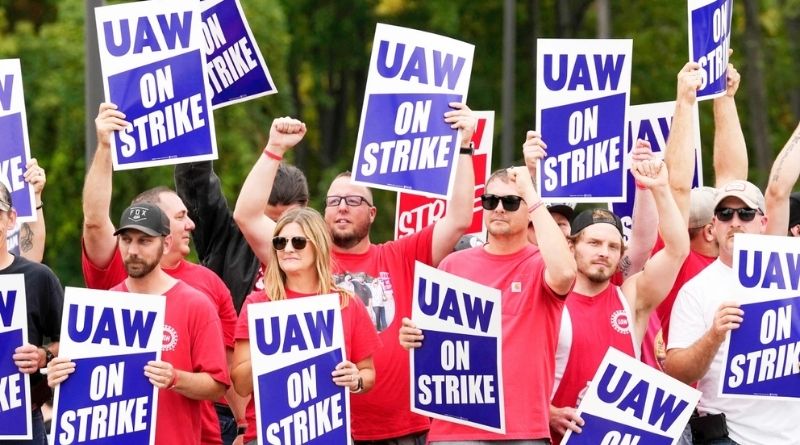
It’s been a tumultuous week for negotiators in Detroit, whose stress levels must certainly be at dangerous heights by now. The UAW strike just passed the one-month mark and it’s hard to tell if we should be wary, weary, or hopeful. The Engine Block has the dirty details of what transpired this past week, along with information on yet another consumer survey that claims to know how American’s feel about EVs.
Plus, Cruise robotaxis got a new update that should stop them from interfering with emergency vehicles; border control issues are compounding automakers’ supply chain headaches; and Tesla is setting a trend with its next-gen manufacturing.
UAW Shifts Tactics
Another day, another UAW strike update. This past week things certainly got interesting in Detroit with union president Shawn Fain showing he’s not afraid to shake up strategy.
Since the start of the strike, the UAW had established a routine of earmarking Fridays as the day it would announce any further work stoppages. Last week, however, Friday arrived on Wednesday when Fain surprised automakers – specifically Ford – by ordering 8,700 workers to walk out of the Kentucky Truck Super Duty factory. He also said additional strikes against the companies could come at anytime, anywhere.

According to Fain, automakers tried to game the system by waiting until Fridays to make any noticeable progress in bargaining. “They thought they figured out the so-called rules of the game,” he said. “So, we changed the rules.”
Ford Feels the Impact
The Kentucky walkout is a tough hit for the Blue Oval, as the site supplies $25 billion a year in revenue and more than $2 billion in profits. Analysts at Wells Fargo estimate that Ford will lose about $150 million per week in core profit from the Kentucky plant strike.
Ford executives insist the latest offer – which includes a 23% wage hike – is “at the limit” of what the company can spend on higher wages and benefits. “We risk the ability to invest in the business and profitably grow,” Kumar Galhotra, president of Ford Blue, the company’s ICE business, told reporters. “And profitable growth is in the best interest of everybody at Ford.”
In response, Fain said CEO Jim Farley should “get the big checkbook” and start reassessing how much money the automaker awards investors in dividends and share buybacks. Today, he also had choice words for Executive Chair Bill Ford who called upon the UAW to reach a tentative deal and put an “end to this acrimonious round of talks.”
“Bill Ford knows exactly how to settle this strike,” Fain said in a statement. “Instead of threatening to close the Rouge, he should call up Jim Farley, tell him to stop playing games and get a deal done, or we’ll close the Rouge for him.”

Hard-Line Bargaining
The UAW’s strike expansions are part of an aggressive bargaining strategy designed to elicit major concessions from the Detroit 3 automakers. And so far, they admittedly seem to be working.
Recent contract offers vary from company to company but overall, they include wage increases of at least 20% for hourly employees as well as higher starting wages for temp workers with shorter progressions to top earning power. GM recently agreed to put battery plant workers under its national contract with the union – a major concession and still-unresolved issue at Ford and Stellantis.
Retirement security remains another sticking point, as the UAW wants to return to defined-benefit pensions rather than 401(k) profit-sharing plans. The automakers claim that such a restoration would lead to bankruptcy.
Where does that leave us?
Analysts seem to be in disagreement over whether or not the Kentucky Truck walkout is a sign that the union’s campaign is nearing its endgame. Pickup trucks are more than just major profit-drivers – they pretty much keep the lights on for these automakers. Shutting down those production lines might just force their hand on some issues. (It certainly puts strain on related parts supply companies, a ripple effect that will add more stress for the automakers.)
GM and Ford are set to report third-quarter results next week. GM already estimated a quarterly hit of $200 million from strike-related costs.

In Case You Missed It…
GM and the Canadian auto workers union, Unifor, reached a tentative labor agreement on Tuesday, following a half-day strike of about 4,300 workers. According to union officials, the three-year contract follows the same pattern set with Ford late last month. Members voted to ratify the deal on Sunday, with 80.5% in favor – a noticeable increase from the slim 54% margin achieved by Ford workers.
New Survey Says: Majority of Americans Won’t Buy EV
Boy, if we had a dime for every time a new survey claims to have insight on American consumer attitudes toward EVs, we might just be able to afford one. Indeed, cost remains an issue for many buyers, at least according to new polling from Yahoo Finance and Ipsos. Other factors influencing the decision to purchase? Range, available charging infrastructure, and environmental impact.
In total, 57% of respondents said they were unlikely to purchase a full EV or plug-in hybrid as their next vehicle.
Yahoo Finance partnered with Ipsos to conduct the survey, noting it asked 1,025 Americans their EV buying preferences and conducted the poll between Sept. 29 and Oct. 1, 2023. There does not seem to be available information on how these respondents were contacted for the survey or where in the country they reside, which could impact results. (Hence why we take all these polls with a grain of salt.)

Regardless, here were a few other takeaways Yahoo pulled out as interesting:
- 70% of respondents over the age of 65 said they were unlikely to buy an EV.
- 60% of respondents with an annual income below $50,000 said they were unlikely to buy an EV.
- Of those respondents who said they were likely to buy an EV, most were in the 35-49 age bracket (37%).
- 42% of respondents with an annual income over $100,000 said they were likely to buy an EV.
- From a political affiliation standpoint, 41% of Democrats would purchase an electric vehicle, whereas only 17% of Republicans would.
- Nearly one-third of all respondents (30%) said they would most likely consider Toyota as their top choice for an EV.
Did You Know…?
Americans might be wishy-washy on electric vehicle technology, but Scandinavians continue to embrace it. Already, EVs make up 63.4% of the market share in Sweden – a number that is sure to grow now that Stockholm plans to ban internal combustion engine (ICE) vehicles from the center of the city starting in 2025. Despite complaints from transport sector companies, officials said they plan to create a “class-three environmental zone” across 20 blocks of inner-city Stockholm.

What Else You Need To Know This Week
Here are a few additional headlines we’re watching and think you should too.
Cruise Robotaxis Get A First Responder-Friendly Update
After several high-profile incidents and a chorus of loud criticism from first responders, Cruise has upgraded its fleet of driverless taxis to better detect emergency vehicles. The announcement came early last week, but is the result of several software updates occurring over the past few months. According to the autonomous technology company, the innovations focused on minimizing operational impact, quickly exiting emergency scenes, and increasing predictability.
What does that look like? Well, Cruise robotaxis now reduce their speed by about 70% once they detect a nearby siren. Additionally, the company said the vehicles’ programming can now better recognize emergency scenes, more accurately predict the behavior of emergency vehicles, and more quickly find a safe place to pull over in the event one is headed their way.
While the Cruise announcement was careful to add that “there may be times when unique and unpredictable situations are unavoidable,” one of the company’s most vocal critics seemed heartened by the updates. The San Francisco Fire Department applauded the software upgrades, as well as the industry’s willingness to problem-solve with city leaders.

Southern Border Congestion Causes Fresh Inventory Headaches
As the U.S.-Mexico border prepares for a new wave of migrant arrivals from Central and South America, the auto industry is experiencing a drastic slowdown in vehicle and parts shipments. The logistics headache is the result of hundreds of thousands of people making their way to the border – many of whom are trying to hitch rides on railway cars earmarked for new-vehicle transport.
The situation led several border crossings to close, causing delays. More drastic, however, was Mexico’s largest railway operator having to suspend service after several cases of injuries or deaths resulting from migrants hopping onto moving freight cars. The company, Ferromex, temporarily halted 60 trains carrying cargo that would fill 1,800 tractor trailers.
Delays are particularly long at the Texas border where cargo trucks must now undergo state inspections, on top of existing federal security checks. The additional scrutiny was implemented to more closely screen for illegal border crossings, as well as drugs, weapons, and human smuggling. Bloomberg reported earlier this month that the extra measures are leading to wait times as long as 24 hours, with at least 19,000 trucks hauling $1.9 billion of goods left idling in Mexico.

Ford & Hyundai Take Page From Tesla’s Manufacturing Playbook
IDRA, the Italian company that builds Tesla’s giant die-casting machines capable of producing single-piece vehicle castings, just added Ford and Hyundai to its client list. According to Reuters, a ‘giga-press 6,100’ with Ford branding on it was spotted being tested at an IDRA plant in northern Italy. An even bigger ‘9,000’ press (which is about the size of a tennis court) was also being tested nearby. A source told the publication it would go to Hyundai and that both models were only for R&D purposes.
The massive giga-presses simplify the manufacturing process, and have the potential to eliminate nearly 400 individual pieces of a car. What that means for the auto workers who handle those pieces will undoubtedly write its own chapter in the ongoing labor movement.
The Engine Block is your one-stop source for any and all auto industry news. Keep an eye on our weekly round-up of enthusiast coverage, product reviews, vehicle spotlights, auto show/expo features, and more. Check back Wednesday for a spotlight on TruXedo’s new Elevate Rack, and then come back around on Friday for a list of the best off-roading trails in New England.


