
Auto Industry News: Collector Cars Cool Down, Tesla Decides to Share, Uber Grabs Headlines, Nissan Trims Leaf & Goodguys Award Chevy Roadster
With Monterey Car Week on the horizon, the collector car market is coming under the microscope — and recent data from Hagerty suggests the red-hot scene may be cooling down. Fuel prices also seem to be declining, but economists are being (very) cautiously optimistic with their predictions. If those numbers have you reconsidering going electric, you’ll be interested to learn Tesla plans to open up Supercharger access to other brands. And if you were hoping to scoop up a cheap little Nissan Leaf, you better act fast. It appears the automaker is cutting the vehicle from its lineup.
The industry was not without its drama last week either, as ride-sharing giant Uber grabbed some eyebrow-raising headlines after internal documents were leaked to the press. The Engine Block unpacks the need-to-know, so you’re up-to-date.
And those of you itching to dwell on a little nostalgic eye candy… Goodguys named its 2022 Classic Instruments Street Rod of the Year – and she is a beaut.

Collector Car Market Cooling Down (A Little)
The results are in from Mecum’s second Summer Special Auction, a four-day event held live at Orlando’s Orange County Convention Center. About 1,500 cars crossed the block, which led to 869 sales for a grand total of $34.8 million.
Now, pre-pandemic, we’d all be nodding our heads at the roughly 60% sell-through rate and saying, “Eh, not too shabby! Things are looking pretty good.” But, after the absolute feeding frenzy of the past two years, during which auction houses experienced repeated record-breaking sales numbers and 85-90% sell-through rates, this all feels a bit… tame by comparison.
According to recent data from specialty insurance provider Hagerty, those feelings are valid.
Crunching the Numbers
Hagerty has long measured collector car market performance, and for the last 15 years, has employed its own Hagerty Market Rating to help it do so. This rating uses a weighted algorithm to calculate market strength and then assigns it a number on a 0-to-100 scale. A score of 80 is what Hagerty considers the threshold for “hyper-appreciation.”
In the past decade-and-a-half – and perhaps more notably, the wild past 2 years – the market never reached this cap. It continued to show an overall tendency to remain flat, even as prices surged and the Hagerty rating steadily increased. In June, however, the Hagerty Market Rating reaching a new all-time high of 78.22, giving the experts a lot to mull over.
We saw this data play out in real time, too. In the case of Mecum, its annual Indy auction (held at the end of May) raked in an incredible $126.5 million in total overall sales, an 18% increase over last year – which itself was a record-breaker over the previous year.

What Goes Up Must Come Down
“Economic uncertainty, among other factors, has begun to affect the classic car market,” Adam Wilcox of Hagerty explains, observing some market cooling. “Classic car sales … are slowing, although there still appears to be an appetite at the ultra-high-end.”
This month, the Hagerty Market Rating reversed 1.42 points to 76.80 – the largest single month drop since the start of Covid. The company reports that auction and private sales activity are both down as median sales prices fail to outpace inflation. Data shows that, overall, prices on classic cars remain high with nearly 50% of cars selling above insured values.
“Indeed, the cheap classic car is quickly becoming a thing of the past,” concludes Wilcox.
With Monterey Car Week about to kick off, collector car experts (and enthusiasts) will be watching closely to see how the market reacts. Younger bidders are landing on the scene, but do they bring a different buying confidence with them?
Fuel Price Drop Speeds Up
Something else that seems to be slightly cooling? Fuel prices. Both gasoline and diesel showed a small but steady decline over the past four weeks. In fact, it marks the longest decline in average gas prices since the pandemic started in 2020, according to Patrick De Haan, head of petroleum analysis at GasBuddy.
“Average gas prices are down nearly 40 cents, with Americans shelling out $140 million less on gasoline every day than they did a month ago,” writes De Haan. If oil prices stay below $105/barrel and gasoline refinery production remains strong, he says the trend could continue – but there are no promises.
“There remains the risk of a spike in prices that could send us to new record levels in August, should any disruptions occur. It could be a wild ride, but for now, the plummet at the pump shall continue.”
So, in what is becoming a personal mantra for many people these days… hope for the best and prepare for the worst.

Tesla: Sharing Is Caring (And Profitable)
Late last month, the White House confirmed in a fact sheet on EV charging that Tesla would be opening its Supercharger network to non-Tesla EVs. The statement noted that Tesla will begin producing the new charging equipment later this year.
Similar open-access programs are already up and running in 13 European countries, though mostly at select stations. Bringing one to North America would certainly aid the administration’s current efforts to mainstream electric driving, namely by helping to tackle consumer fears of range anxiety.
It would also mean access to some serious money for Tesla.
By playing the sharing game, the automaker becomes eligible for infrastructure bill funding earmarked for EV charging – some $5 billion worth of federal money.
Eligibility and approval are certainly two different things, though. And after Musk tweeted earlier this year that President Biden was “a damp sock puppet in human form,” the odds on whether or not his company will actually get any of that funding feels tenuous at best.

Uber-Bad PR
Another controversial CEO found himself in the news last week, though for decidedly more explosive reasons. Leaked documents reveal that Travis Kalanick, co-founder and former CEO of Uber, was involved in serious, ethically-questionable behavior when he was heading up the company. This would be in addition to the series of already-documented scandals, discrimination complaints, and sexual misconduct allegations that saw him ousted from his position during a shareholder revolt in 2017.
More than 124,000 confidential documents were leaked to the Guardian, and cover a five-year period between 2013 and 2017. The data reveals Kalanick and others at the company knowingly broke laws, blocked data during police raids, lobbied heads of state, paid for biased research reports, and even endangered drivers by “weaponizing” them in a bid to build controversy and media attention.
From the Guardian:
The cache of files … includes more than 83,000 emails, iMessages and WhatsApp messages, including often frank and unvarnished communications between Kalanick and his top team of executives.
In one exchange, Kalanick dismissed concerns from other executives that sending Uber drivers to a protest in France put them at risk of violence from angry opponents in the taxi industry. “I think it’s worth it,” he shot back. “Violence guarantee[s] success.”
He Said, She Said
Mark MacGann, Uber’s head of public policy for Europe, Middle East and Africa has come forward as the source of the leak. “It is my duty to speak up and help governments and parliamentarians right some fundamental wrongs,” he said. “Morally, I had no choice in the matter.”
Kalanick’s spokesperson, Devon Spurgeon, denied the claims and questioned the authenticity of the documents. She also shifted blame from Kalanick directly, noting that “Uber’s expansion initiatives were led by over a hundred leaders in dozens of countries around the world.” (You can read Spurgeon’s full statement here.)

Jill Hazelbaker, Uber’s svp of marketing and public affairs, said in a statement that the company “will not make excuses for past behavior that is clearly not in line with our present values. Instead, we ask the public to judge us by what we’ve done over the last five years and what we will do in the years to come.” (You can read her full statement here.)
“When we say Uber is a different company today, we mean it literally: 90% of current Uber employees joined after Dara became CEO,” she added.
Dara is Dara Khosrowshahi, who became Uber’s CEO after Kalanick’s forced departure. Khosrowshahi’s leadership style has led to many reformative changes at the company, which he instituted in hopes of rehabbing Uber’s reputation – and making it profitable.
Whether these leaked documents make his job harder or easier is yet to be seen. As PT Barnum said, “There’s no such thing as bad publicity.”
Nissan Trims Leaf
It appears Nissan is looking to further cut back its vehicle lineup. Last week, we reported on industry whispers that the Japanese automaker plans to pull its Nissan Titan from the full-size pickup market, after the vehicle failed to put up any real competition against domestic rivals.
Now, several sources confirmed to Automotive News that the compact Nissan Leaf – a pioneering EV in its own right – will not see a next generation. Instead, the manufacturer will replace it with a new model “more tuned to the needs of the modern EV buyer.”

Similar reasoning seems to back this decision as well. Ed Kim, president of automotive marketing research AutoPacific, noted the Leaf’s lack of brand power among EV shoppers. With “more product updates, better design and a CUV body style,” it may have stayed competitive, he told Automotive News, but the automaker’s “miscalculation” held the Leaf back from achieving viable market penetration.
No word yet on what could replace the little electric hatchback. The publication predicts a “coupelike crossover,” perhaps something in line with Nissan’s “Chill Out” concept car from 2021.
Did you know…?
Retail giant Walmart recently threw a lifeline to struggling EV company, Canoo, by ordering 4,500 delivery vans. Barely two months ago, the electric startup announced it was so cash-strapped that it likely would not be able to meet its financial obligations. While the Walmart deal certainly helps keep Canoo afloat (stock nearly doubled after months of steady decline), the company still needs to drum up cash for production. And, as the recent wave of SPAC-backed EV makers are beginning to learn… vehicle manufacturing is not easy business.

Name Change
Shifting to the aftermarket, truck accessories juggernaut, Truck Hero, made a big announcement last week that it was changing its name to Real Truck, effective immediately. If the new moniker sounds familiar, that’s because it’s been the name of the company’s e-commerce arm and consumer brand since 2015.
According to a press release, the name change will help “grow consumer awareness and interest in the truck accessories category,” especially as “truck owners’ preferences and purchase patterns evolve.”
Essentially, it will simplify things, and make it easier for shoppers to learn about and find truck, Jeep, and off-road accessories. In turn, the company expects the change to benefit dealer and installer partners as well.
A Little Eye Candy
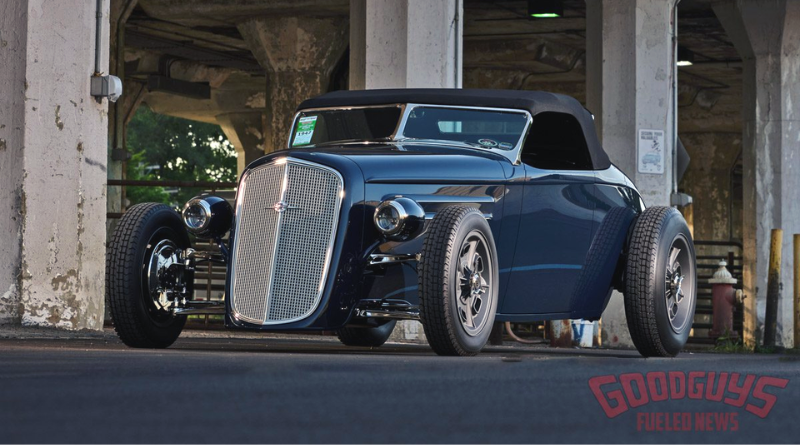
With so much happening in the auto industry, sometimes it’s nice to indulge in a little beauty from the past. This 1934 Chevy Roadster, which just nabbed Goodguys’ 2022 Classic Instruments Street Rod of the Year at the 24th Summit Racing Nationals, certainly fits the bill.
Owned by Jeff Breault, and built by Wichita-based Devlin Rod and Customs, the incredible and uncommon vehicle is just the fourth Chevy to win the coveted title, according to Goodguys’ news outlet, Fuel Curve. Breault harbors a longstanding love of GM products, and said he knew when he decided to build a roadster, “it had to be a Chevy.”

With very few built in the U.S. (only about 1,800), Breault sourced this beauty from Australia. It is number 29 of 31 built in 1934 by Holden. The project involved a lot of clever planning to incorporate modern performance in a vintage way, including custom valve covers to help the 650-hp LS resemble a WWII-era Merlin engine. There are also drum-style backing plates disguising Wilwood disc brakes. The plates themselves are hidden behind 16- and 18-inch custom knockoff aluminum wheels coated to look like magnesium offerings more in line with ’50s-era Indy racers.
Check out Fuel Curve for more photographs and a detailed run-down on the build.
The Engine Block is your one-stop source for any and all auto industry news. Keep an eye on our weekly round-up of enthusiast coverage, product reviews, vehicle spotlights, auto show/expo features, and more. Be sure to check back Friday for a rundown of top summer sites for you and your truck.


