
Auto Industry News: Mecum Indy Preview, VW Prank Earns SEC Scrutiny, Chicago A Go, Electric F-150 Gets A Name, and the Problems With Level 2 Charging
Auction season is in full swing and Mecum has an incredible lineup in store for next week’s Indy 2021. On the new car circuit, the Chicago Auto Show gets the greenlight for this summer, though it will look a little different than years’ past. The Electric F-150 gets an electric-sounding moniker and a new survey reveals some troubling issues facing the full-scale adoption of EVs.

Get Your Bids Ready for Mecum Indy 2021
What better way to ring in spring than with a loaded docket of stunning, one-of-a-kind collector cars at one of the world’s premier auto auctions?
The 34th annual Mecum Spring Classic – also known as Mecum Indy – kicks off this Friday (May 14) at the Indiana State Fairgrounds & Event Center in Indianapolis. As Mecum Auctions’ annual flagship event, Indy 2021 has some high expectations to live up to. And this year, with 2,500 vehicles set to cross the block — running the gamut from vintage muscle to modern performance to ultra-rare exotics — the beloved Wisconsin-based auction house is bringing the heat for those planning to splash the cash.
More than two dozen collections of cars, motorcycles, road art, and more are set to make an appearance over the nine auction days. All are worthy of your attention, but we highlighted a few stand-out attractions you won’t want to miss.
Bronco, Baby
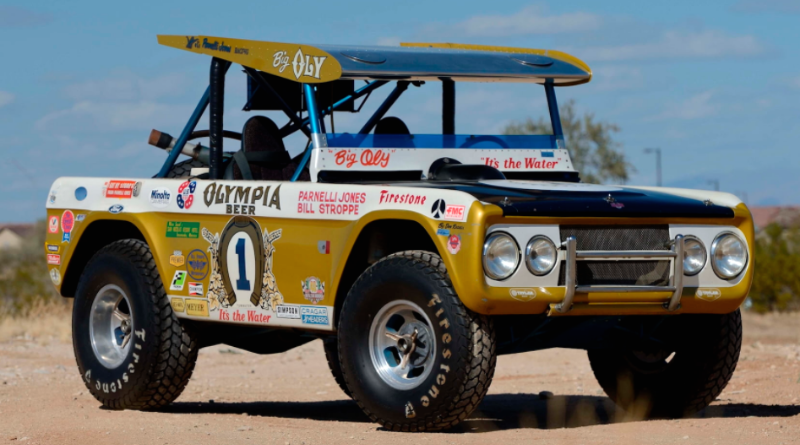
Perhaps the buzziest draw for Indy 2021 is “Big Oly” – Parnelli Jones’ immensely capable Bronco-inspired off-road racer. As Ford lumbers along bringing this resurrected badge back to market, collector car nuts are chomping at the bit to own a piece of nostalgia. While there’s no estimate listed for Big Oly, you can expect it to be – well – Big.

Perhaps the world’s most famous Bronco, Big Oly boasts back-to-back Baja 1000 victories (1971 & 1972), as well as wins in the 1973 Baja 500 and 1973 Mint 400. Based on a 1969 Bronco, the vehicle was built to Parnelli Jones’ unique specifications aimed to make it faster, stronger, and lighter than a traditional Bronco. Featuring a tube frame and body made of fiberglass and aluminum, Big Oly’s construction completely changed the way future off-road racers approached vehicle design.
Read more about Big Oly and see the specs, here.
According to Mecum, several other significant offerings from Jones’ private collection will join Big Oly in Indy, including a Formula One Race Car (Lot F132), two Saleen Mustangs (Lots F134 and F135), Road Art items and more.
Seeing Red
Speaking of buzzy vehicles living rent-free in your head…
While the new C8 Corvette continues to turn heads, Mecum offers up a little blast from the past. Check out the six, stunning red-on-red award-winning and highly original Chevrolet Corvettes from the Dr. Mark Davis Collection (Lots F191 to F196).
According to the auction house, the earliest model in the collection, a 1958 convertible (Lot F191), is one of just three 1958 Corvettes to have secured the NCRS Bowtie award, while the 1966 Chevrolet Corvette Convertible (Lot F194) stands as the lowest-mile 427 Corvette from that year known to exist with just 11,400 miles on its clock.

Mo’ Mopar
If you reach for that top-shelf Mopar, Mecum has four that should be on your radar. All headlining the Class of ’71 Collection, they include:
- A 1971 1971 Plymouth Hemi Cuda Convertible (Lot F166) that is one of 12 produced in 1971 and one of only three equipped with the factory A833 4-speed manual transmission;
- A 1971 Plymouth Cuda Convertible (Lot F167) that is one of only five V-Code Cuda convertibles produced in 1971 with a factory 4-speed and one of just three V-Code 4-speed Cuda Convertibles with the factory shaker hood;
- A 4-speed 1971 Plymouth Hemi Cuda (Lot F168) with just 25,200 miles;
- And an unrestored 1971 Dodge Hemi Challenger R/T (Lot F169).
Tune into NBC Sports May 14 – 22 to catch all the action of Mecum Indy 2021, including what sells and who’s lucky enough to be handed the keys!
Chicago Auto Show Scheduled for July
Just like many other events springing back into action after a year on the back-burner, the Chicago Auto Show is officially on the 2021 schedule.
As one of the only organized auto shows to enjoy a successful run before COVID hit the world like a runaway truck, showrunners hoped to stay on track with a full event this year as well. Those plans were originally postponed to Spring, due to the ongoing nature of the pandemic. Now, the event is slated for July.

To account for safety, show organizers are taking a similar route as the Detroit Auto Show, keeping things short and sweet. Obviously, the crowds will be smaller than normal, social distancing and mask-wearing will likely still be required, and instead of the normal nine-day event, the show will only run July 15- 19.
For those who still love going to in-person shows, we have our fingers crossed that the Chicago Auto Show might signal a shift towards normalcy.
VW “Voltswagen” Prank Earns SEC Investigation
If you happened to be on the hunt for the goofiest story of the week, look no further dear reader!
VW found itself in some hot water this week, after its “humorous” advertising and marketing ploy backfired terribly. On March 29, the German automaker pulled a prank in poor taste, “accidentally” releasing an unfinished press release that declared the company was changing its name from “Volkswagen” to “Voltswagen,” as part of its efforts to go all-in on EVs.
Spoiler alert: There was no actual plan to change the brand’s name.
Unfortunately, what was meant to be a cute and innocuous joke got international press. When questions were raised, VW doubled-down on its incredible misunderstanding of how April Fool’s Day jokes actually work and proceeded to assure members of the media that this was really happening. It’s not a joke, guys. No way. We’re totally doing this.
The ensuing hullabaloo resulted in a significant stock price bump for Volkswagen – at one point jumping 12.5%.
By April 1, the cat was out of the bag and VW prepared for a nice round of shared laughter. Instead, the automaker was met with journalistic complaints, consumer eye-rolling, and the unwanted, ever-watchful stare of the Securities and Exchange Commission.
Despite an apology, news broke last week that the SEC is launching a federal investigation into the matter to determine if the “Voltswagen” debacle unfairly influenced the brand’s stock price.
You may remember Elon Musk’s dance with the feds back in 2018 when he tweeted about taking Tesla private at $420. Two little words, “Funding Secured,” cost the EV startup titan a whopping $40 million in penalties – plus his seat as Chairman of the Tesla board. So, while we don’t anticipate a hefty fine akin to Dieselgate, there’s a good chance VW will need to open its wallet.
Ford All-Electric F-150 Reanimates “Lightning” Badge
It’s aliiiive… Ford’s new all-electric F-150 pickup truck will resurrect an old badge from the dead and wear the name F-150 Lightning. Borrowed from V-8 street trucks of the ‘90s and early ‘00s, we have to say this is an objectively cool name for an electric truck and we love this move for Ford.
The automaker has yet to release any hard details on the F-150 Lightning’s powertrain or design, though we do know it will sport a dual-motor setup providing all-wheel drive. Ford says the electric truck – which debuts May 19 – will offer more horsepower and torque than any F-150 currently on the market, making it the fastest accelerating F-150 too.
According to Car and Driver, the F-150 Lightning’s battery pack will likely provide more than 300 miles of range, as its cousin the Mustang Mach-E is EPA-rated at 305 miles of driving range. “Ford also patented a removal range extender that could go in the truck’s bed.”
Ford sold a whopping 787,422 traditional F-Series trucks last year alone. And with contenders like the Hummer EV, all-electric Silverado, Rivian RT1 and, of course, the Tesla Cybertruck, the Lightning will have its work cut out in drawing consumer attention.
Speaking of new Ford monikers…
The Blue Oval’s most recent Explorer model — the Timberline — has officially been revealed. The rugged model features a lifted suspension, all-terrain tires, standard all-wheel drive, and a Torsen limited-slip rear differential, making it what Ford calls “the most off-road-capable Explorer ever.”
While it feels a bit like a genetically-modified, enriched-wheat-flour version of the OG off-roading family hauler of the early 00s, we’ll admit it looks sharp — and the capability seems impressive. Read more about the new Explorer Timberline, here.
Level 2 Charging Poses Threat to Mainstreaming EVs
At this point, the writing on the wall has been clear: EVs are coming and there’s nothing you can do to stop it!
But as automakers pour billions into development and governments work on mandating the death of internal combustion, consumer sentiment remains iffy. Sure, shoppers are interested in EVs. Deloitte reports 41% of U.S. drivers say they would consider an alternative to a gas-powered car for their next vehicle – an increase of 29% from the previous year. And prices are slowly coming down, as range ability goes up.
However, new research from Nature Energy, indicates 20% of California EV drivers, or 1 in 5 people, plan to switch back to gasoline-powered cars.
While survey respondents reported a variety of issues contributing to this change, one stood a little taller than the rest: access to Level 2 Charging.

The Charging Conundrum
At the moment, more than 80% of EV owners do the bulk of their charging at home, where they often install 240-volt Level 2 chargers. (Standard home outlets generally put out about 120 volts of power, which in EV lingo is called “Level 1” charging.) For those who rent or live in an apartment building, installing a Level 2 charger is often simply not feasible. That means, they’re facing very long charging times.
Even with Level 2, charging can be inconsistent and inconvenient. Bloomberg automotive analyst Kevin Tynan told Business Insider that even with the faster charging, a Chevy Volt he tested still needed nearly six hours to top its range back up to 300 miles from nearly empty.
It’s true that public chargers provide faster charging capabilities. However, the study showed that some two thirds of EV owners said they never use public charging. Unfortunately, no reason was qualified, denying us some very valuable input on whether this lack of use was due to poor access, charger-vehicle incompatibility, or even broken charging units.
A Grain of Salt
While this survey reveals a very important hiccup in EV adoption – the glaring lack of quick-charging support for owners – there are some important parameters to point out.
First, this was a small survey, with only 4,160 participants. It was also limited to one state: California, which boasts a population of nearly 40 million people and – for what it’s worth – continues to lead the way in U.S. EV adoption. (Last clocked at 9% in Q1 2021.) Additionally, the study examined EVs purchased only between 2012 and 2018. As KBB points out, “both the number of available electric cars and the number of available chargers has increased since then.”
Challenges & Plans
Getting companies to see the monetary value in a robust EV infrastructure continues to be a challenge, leading to the current administration’s recent affinity for federally subsidized electric infrastructure and EV tax breaks. In addition to President Biden’s massive $15 billion investment in a “robust, convenient, and affordable” 500,000-unit national charging network, Representatives Alexandria Ocasio-Cortez, D-N.Y., and Andy Levin, D-Mich are pushing a new piece of legislation called the Electric Vehicle Freedom Act.
The Electric Vehicle Freedom Act aims to double down on Biden’s pledge, adding billions more dollars into building hundreds of thousands of interoperable electric-vehicle-charging stations around the U.S. within five years, and shifting government funding and tax breaks away from internal combustion vehicles and toward EVs.
Regardless of how you feel about the allocation of federal dollars, just the posing of this legislation is noteworthy. That writing on the wall “EVs are coming” just took on some sharper focus…
The Engine Block is your one-stop source for any and all auto industry news. Keep an eye on our weekly round-up of enthusiast coverage, product reviews, vehicle spotlights, auto show/expo features, and more. Be sure to check back Friday for our Springtime Chemicals Rundown with a focus on must-have tools to wash away those winter blahs.


