
Auto Industry News: Vehicle Prices & Profits Rise, Collector Car Market Smashes New Records, and Campgrounds Grow More Crowded
Someday, students will crack open their textbooks and marvel at what they read about this era we’re now living in. The economic ramifications alone will be dissected and debated for decades – with the auto industry no doubt being a flashpoint topic. This week, The Engine Block unpacks some of the big industry trends affecting manufacturers, dealers, and consumers like you. Keep reading to learn how things are looking in the new and used markets (expensive), on the collector car scene (buoyant), and out at the campgrounds and parks (crowded).
Industry Pressures
The exhaustive list of pressures, limits, shortages and other catastrophes now facing the automotive industry has professionals and consumers alike shaking their heads in disbelief. From a global health crisis driving constant uncertainty to a semiconductor chip shortage fueling low vehicle inventory, the obstacle course facing manufacturers grows more complex every day. Throw in a very expensive shipping container traffic jam; technician, driver, and labor shortages; inflation levels not seen since the ‘80s; possible war in Ukraine causing nervous hiccups on Wall Street; and a potential palladium shortage from Russia.
Frankly, it’s amazing this industry is still standing.
But it is. And with consumer demand remaining incredibly high, automakers and dealers are enjoying record-making profits.

Volume Down, Revenue…Up?
While new-vehicle retail sales in January came in at an estimated 828,900 units — 8.3% lower than January 2021’s numbers — new-vehicle prices continue to sit at record levels. Average transaction prices are expected to reach a whopping January record of $44,905, up 12.5% since last January. Adding insult to injury, vehicle incentives offered by manufacturers fell 40% on average per vehicle compared to January 2021.

Driving these sky-high price tags is a pervasively low volume of new vehicles across all segments. January month-end retail inventory was estimated below 1 million units, marking the eighth consecutive month of anemic product levels. This puts the seasonally adjusted annualized rate (SAAR) for total new-vehicle sales at 14.1 million units, down 2.6 million units from 2021.
Astoundingly, per-unit profit gains are offsetting the drop in sales volume — the total aggregate retailer profit from new-vehicle sales is projected to be up 117% from January 2021! That translates to an incredible $4.3 billion. J.D. Power estimates consumers spent an eyewatering $37.2 billion on new vehicles in January, the highest on record for the month of January and 10% above January 2020. Unsurprising, perhaps, since industry sales data reveals over 80% of those who bought a vehicle in January paid more than MSRP.
But that doesn’t mean American consumers will stick around waiting for their preferred model for long. In fact, Kelly Blue Book reports some have already impatiently left the market.
The Great Seller’s Market
Record new-vehicle prices are being supported by exceptionally strong used-vehicle prices, as new-vehicle buyers benefit from more equity on their trade-in vehicles. The average trade-in equity for January trended toward $9,852, an 88% increase of $4,611 from a year ago. According to the U.S. Labor Statistics Bureau, used car and truck prices are up 40.5% YOY in January.
There are signs, however, that the red-hot used vehicle market could be cooling down – at least a bit. Sales were down 4% YOY in December, and inventories increased to 54 days compared to the normal used retail inventory of 44 days. Wholesale supply was also elevated, ending December at 33 days, above the normal 23.

On the hunt for a new ride? Consider looking at KIA or Hyundai. The Korean sister brands earned three of the top four rankings in the 2022 U.S. Vehicle Dependability Study by J.D. Power. This is the first year KIA leads the overall ranking of the brands with the fewest reported problems after three years of ownership. Hyundai’s luxury brand Genesis ranked highest in the premium segment. Other mass market brands ranking high for vehicle dependability include Buick, Hyundai, Toyota and Dodge.
Policy Makers See The Light
It’s happened to every weary nighttime driver on a lonely road. As oppressive darkness smothers the landscape just beyond your headlight’s reach, suddenly a light brighter than a thousand suns pierces the horizon, blinding you. Could it be a UFO? A streaking meteor? A bolt of lightning? Nope – it’s just a Jeep Cherokee.
Car headlights have gotten much brighter over the past decade with the advent of advanced LED technology. Product developments to solve this issue were introduced in new models many years ago in Europe and Asia, but outlawed in the U.S.
Until now.
Buried in the infrastructure bill recently passed in Congress is a clause that legalizes adaptive headlights, a technology that can redirect harsh beams of light away from other cars and pedestrians. The law gave Transportation Secretary Pete Buttigieg two years to enact the rule, but the department moved much faster than required. It went into effect last Tuesday, according to Kelly Blue Book.

Learn more about innovative illumination in our recent coverage of automotive lighting trends.
Hammer Time & NFT Milestone
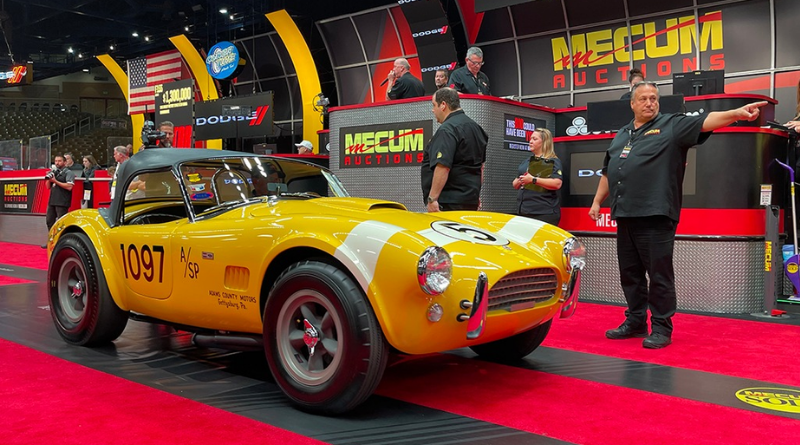
The collector car market, already cruising toward record valuations and interest levels before the pandemic, has exploded upward, outward and beyond. Auction houses continue to slay sales records, attracting dollars and widespread interest like never before.

Mecum Auctions, Barrett-Jackson and RM Sotheby’s all had a January to remember, auctioning off more than $460 million in vehicles and memorabilia during three respective sales. Among those events, the crown for highest bid price for a single car went to Sotheby’s, which saw a 1955 Mercedes-Benz 300 SL Alloy Gullwing sell for $6.8 million.
In perhaps the most indicative sign of the times, Sotheby’s also sold a 1988 Cizeta-Moroder V16T alongside a matching NFT (non-fungible token) for $1.3 million. It’s the first time – and more than likely not the last – an NFT was associated with a car auction by Sotheby’s.
Meanwhile, Barrett-Jackson had its most successful collector car auction in its 50-year history during Arizona Auction Week. In total,1,857 vehicles moved for $195.9 million, with a 100-percent sell-through rate and over 140 world-record auction sales achieved. The auction house also raised more than $8.8 million for charity through the sale of 10 vehicles in Arizona.
The auction’s top-three highest netting vehicles were:
- 2004 Porsche Carrera GT – $1,980,000
- 1955 Mercedes-Benz 300SL Gullwing – $1,870,000
- 2015 Porsche 918 Spyder – $1,815,000

Tune In
Over in Kissimmee, Florida, Mecum held its own sale to great effect. The company set its all time single-event auction record, pulling in more than $217 million on a 90 percent sell-through rate. But perhaps more impressively, TV coverage of the event set new watermarks, demonstrating torrid interest in the collector car hobby.
Kicking off a new partnership with MotorTrend TV, the Mecum Kissimmee auction attracted 6.3 million viewers – the largest TV audience ever for the event and a viewership increase of 76% versus last year’s January 2021 telecast on NBC Sports Network.
Viewers were treated to a full slate of drool-inducing rides, like a 1965 Shelby GT350R Prototype – recognized as the most historically significant Shelby Mustang in the world and driven by Ken Miles to claim its Flying Mustang moniker. Selling for $3.75 million, the car proved to hold its value with its return to the public market, retaining its crown as the most valuable Mustang in the world, according to the auction house.

Other highlights included a 194-mile 2020 McLaren Speedtail from The Michael Fux Collection – one of just 106 built – selling for $3.3 million; as well as a custom 1951 Hirohata Mercury built by Sam and George Barris, crossing the block for $2.15 million.
Map Quest
If the winter camping season is any indication, the overlanding and off-roading industry is set for another huge spring and summer.
Winter is the fastest-growing camping season, and the best way for outdoors lovers to avoid big crowds and bugs. Results from a survey of over 3,000 users of The Dyrt mobile app indicate camping is increasing in popularity throughout the year, but the most significant change has come in the coldest months with winter camping up 40.7% since 2019.
“For some people, solitude is one of the things they love most about camping,” said Kevin Long, CEO of The Dyrt. “With the surge in camping over the last two years filling up campgrounds, more and more people are realizing that there are amazing camping experiences to be had all year round. A lot of campers are currently busy planning trips for 2022, but many are out there right now braving the cold and finding their peace.”

Thinking about heading off-grid this winter? Check out our list of top cold-weather camping destinations.
When the frozen tundra does thaw this spring, there’s certain to be more RVs parked alongside tent campers. According to Go RVing’s RV Owner Demographic Profile, 11.2 million American households now own an RV — a 62% increase from 20 years ago. Nearly a third of those people in the study are first-time owners. While RV ownership has long been associated with retirees and snowbirds, there’s been significant growth among 18- to 34-year-olds, who now make up 22% of the market.
Reservation, Please
Public investment also continues to grow, with a record $1.5 billion in annual funding promised through the Wildlife and Sport Fish Restoration (WSFR) Program through the U.S. Fish and Wildlife Service. The funding will go to support state and local outdoor recreational opportunities, and wildlife and habitat conservation efforts.
“Over the past two years we saw record outdoor participation and sales of outdoor products – from RVs, bikes, and boats to hunting and angling gear and equipment and more,” said Jessica Turner, president of Outdoor Recreation Roundtable. “More outdoor activities directly correlate with increased funding for land and water conservation, outdoor infrastructure, and habitat improvement.”

Of course, with public investment comes shortfalls.
The Great American Outdoors Act has been a success by most measures, but there’s still a glaring need for more resources to tackle maintenance projects in national parks.
During a hearing in the U.S. Senate last Wednesday, officials said the $9.5 billion being invested as part of the Great American Outdoors Act is cutting through the large backlog of projects, but it’s simply not enough, according to the Ohio Capital Journal.
“I know that $9.5 billion is a large sum,” said Maine independent Senator Angus King, chair of the Senate Subcommittee on National Parks. “But it represents only a portion of the funding needed to eliminate the more than $25 billion – a current estimate – in deferred maintenance needs plaguing our public lands.”
One of America’s most popular parks, Yosemite National Park is feeling the investment — receiving more than $100 million in federal funding. In fact, the park has so many ongoing construction projects that it’s been forced to utilize a reservation system for visitors who come between 6 a.m. to 4 p.m. Visitors in off hours don’t need a reservation, but still need to pay park entry fees. Yosemite is using the funds for campgrounds, trails, roads and more.
The Engine Block is your one-stop source for any and all auto industry news. Keep an eye on our weekly round-up of enthusiast coverage, product reviews, vehicle spotlights, auto show/expo features, and more. Be sure to check back Friday for our next Competition Corner – a comprehensive round-up of upcoming automotive events!


