
Auto News: KOH Kicks Off, Mecum Makes History, Hackers Find New Loopholes, & Chevy Set To Make More ICE-Powered Corvettes
The new year is off to a roaring start. Off-road racers are already kicking up dirt and laying down gnarly runs at King of the Hammers, while classic car enthusiasts set their own kind of records on the auction front. The ink is officially dry on final tallies from Mecum’s Kissimmee event, and American Muscle fans will be happy with results. Meanwhile – exciting news dropped regarding the C9 Corvette, automakers are showing renewed interest in mini trucks, and hackers helped close a few more security loopholes at a number of automakers.
King of the Hammers Kicks Off
While the official Race of Kings is still a good 12 days out, the gates to Hammertown are already open and the 2023 King of the Motos already crowned.
After starting in a hard-earned P1, Canada’s star Enduro rider Trystan Hart was first to cross the finish line in Sunday’s race in the Pro Mens Class. This marks back-to-back wins for Hart, who took KOM victory in 2021. (The event did not take place last year.)
Registration for KOM jumped 30% this year with over 150 moto riders competing in the grueling event, which doubled as the first stop on the U.S. Hard Enduro Tour. Sunday’s race included two loops on the formidable GPS-based course – roughly 12 miles and 13.5 miles each. They crossed exciting but brutal terrain, riddled with sharp rocks and loose dirt.
Despite coming off a nasty wrist injury during the 2022 season, 5x King of the Motos champ Cody Webb still managed to put in an incredible race and finish second behind Hart. Ryder LeBlond, the youngest and newest member of Husqvarna Factory Racing, took third.
In the Pro Womens Class, the ladies showed they’re determined to work hard and step up the sport. Kylee Sweeten took the crown, winning out over KOM first-timer Hallie Marks in second and Bailey Lerwill in third.
Tune into King of the Hammers official YouTube channel for live stream coverage. Pre-running opens on Thursday, and the next event to hit the dirt is the Toyo Tires Desert Challenge on Friday night.
Mecum Makes History – Again
Jumping to the complete opposite end of the enthusiast spectrum, Mecum Auctions slammed the final gavel on its annual Kissimmee event exactly two weeks ago – which means, final numbers are now tallied and inked into the record books.
The results? The auction once again smashed sales records, eclipsing last year’s best of $217 million to deliver an unprecedented $234 million in total sales over 12 days.
Mecum Kissimmee 2023 also celebrated the highest number ever of vehicles consigned at 4,000 as well as the highest number of vehicles sold at 3,180. The auction house also reported record attendance of both registered bidders and spectators.
However, as the number-crunchers over at Hagerty wisely point out, sell-through rate was down this year “indicating a wider gap between buyer and seller expectations.” Additionally, vehicles with less-than-perfect pedigrees saw mixed results among bidders.
Still, it was an impressive showing with a remarkably diverse lineup thanks to the more than 45 private collections in attendance, which together produced $90 million in sales. A familiar badge topped the high sellers list, with a rare 1992 Ferrari F40 (Lot S156) selling for $3.135 million. American muscle performed exceptionally well, though, as several top-tier examples reached six and seven figures. A 1970 Pontiac GTO Judge Ram Air IV Convertible (Lot F111) sold for $1.1 million, marking it one of the most expensive muscle cars ever sold at auction and the most expensive GTO.

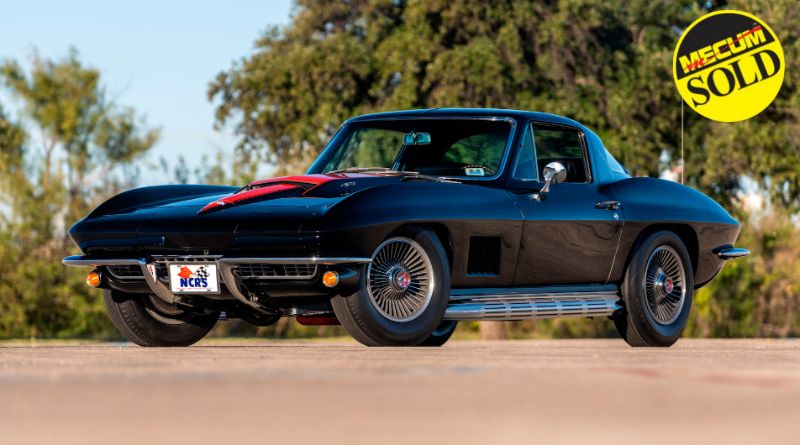
Corvettes made an impression, as well. (When do they not?) Several beauties crossed the block, including the earliest-known second-gen Corvette in existence – which sold for an incredible $467,500. Amazingly, this marked it as the second highest-selling ‘Vette at the auction. A multiple-award-winning 1967 Chevrolet Corvette Coupe (Lot F156) took first at $495,000.
Corvette C9 Expected to Be ICE-Powered 2029 Model
Speaking of Corvettes… Excitement for the C8-generation and its introduction of a mid-engine setup has barely died down, and already anticipation is building for the next iteration of America’s sports car. Moreso in the last week, as news emerged that the C9 model will likely arrive in 2028 as a 2029 model and feature good old ICE power, rather than the electric propulsion we all assumed.
According to GM Authority, the next-generation C9 Corvette will ride on a revised variant of the GM Y2 platform that underpins the current C8 Corvette. “Critically, [it] will feature internal combustion for motivation, and will not be directly related to the upcoming Corvette EV sedan and Corvette EV crossover currently in development,” the site notes.
In the meantime, GM continues to push against consumer expectations for the existing model.
Earlier this month, the automaker dropped a new, all-wheel-drive hybrid version called the Corvette E-Ray. With a 119-kW electric motor at the front wheels and the Stingray’s 6.2-liter LT2 V-8 engine out back, the E-Ray creates a combined 655 hp and 595 lb.-ft of torque – putting it within spitting distance of the all-new 2023 Z06 performance model with which it shares much of its styling. According to Chevy, the new E-Ray can reach 60 mph in as little as 2.5 seconds and can conquer the standing quarter-mile in a mere 10.5 seconds.
As if that weren’t enough, Chevy plans to drop two more C8 variants. First to arrive in 2023 will be an aggressively-styled and supremely capable Corvette ZR1, powered by a twin-turbo V-8. Then, for the 2024 model year, Chevy plans to pair the aforementioned twin-turbo powerplant to a hybrid-electric drivetrain and create a new ultra-high-performance flagship Corvette, dubbed “Zora.”

Did you know…?
GM announced its plans to invest nearly a billion dollars to produce the company’s sixth generation Small Block V-8 engine. Most of the money will go to preparing four U.S. manufacturing sites in Michigan, Ohio and New York, with a small portion also earmarked for castings and components to support EV production at two of these facilities.
Automakers Mulling EV Mini-Trucks
After seeing the success of Ford’s mini-but-mighty Maverick, it appears fellow automakers are reconsidering the little truck segment. Two separate news reports emerged last week, revealing that both Nissan and GM are tossing around the idea of launching small electric pickups in the near future.
While the Ford Maverick is not an electric model, it does come standard with a 2.5-liter, four-cylinder hybrid engine. It also sold so well that Ford had to suspend ordering to keep up with demand.
Simply put: competing manufacturers want a piece of that pie. And crosstown rival GM technically already has a design to work with.
Automotive News reported earlier this month seeing a two-door pickup with a 4- to 4.5-foot bed and low roofline at GM’s affordable EV design studio in Warren, Michigan. Designed to gauge consumer interest, the prototype is not guaranteed to hit production. However, it does show that GM sees potential in resurrecting (and reimagining) a mini pickup.

If GM has the rough draft to lean on, then Nissan has the history. The automaker arguably helped launch the mini truck segment with its little Hardbody haulers from the 80s and 90s. Built like bricks, these compact pickups still zip up and down highways today.
Apparently, Nissan is interested in revisiting those roots. Again, according to Automotive News, the Japanese manufacturer is reportedly eyeing up the segment – largely because dealers are asking for it. As the full-size Titan withers on the vine, it’s looking more like the Nissan truck stable may soon shrink down to a Frontier-only menu. Offering an electric version of the popular pickup would be a “logical” extension for the brand, Nissan Dealer Advisory Board chairman Tyler Slade told AN.
EV Update
After going public via SPAC and reaching a whopping $2 billion market valuation, EV charging operator Volta is selling out to Shell for pennies on the dollar. The oil giant is buying the company – and its 3,000+ strong charging network for a mere $169 million. Last year, Shell also purchased the UK’s largest electric vehicle charging network, Ubitricity, for an undisclosed amount. Diversify assets or hedging bets? Whatever the case, it looks like the new energy boss will look a lot like the old one.
Hackers Find New Loopholes
The Digital Age may introduce exciting new technology, designed to bring comfort and convenience to our lives, but it also ushers in new problems – notably, cybercrime. Thankfully, ‘white hat’ hackers have stepped up their preventative efforts of late, discovering and helping to close security gaps in the automotive industry.
Their most recent accomplishment was exposing vulnerabilities in customer and back-end operations at BMW, Ferrari, Ford, Jaguar-Land Rover, Mercedes-Benz, Porsche and Rolls-Royce. The security researchers also found access threats at telematics company Spireon and license plate seller Reviver.
The findings were released after a 90-day waiting period, to provide the companies time to develop reliable fixes. It appears all parties have addressed the breaches, taking remedial measures and in some cases, shoring up defenses even further.
This same security group made headlines last year, as well. In late November, they explained via Twitter how they helped close a pretty large authentication gap at Sirius XM radio. The issue there had similar ramifications, as it could allow ill-intending hackers to not only access personal driver data but also remotely control certain car functions.
Super excited to release our car hacking research discussing vulnerabilities affecting hundreds of millions of vehicles, dozens of different car companies:https://t.co/xCHG5oLYWK
Contributors:@_specters_ @bbuerhaus @xEHLE_ @iangcarroll, @sshell_ @infosec_au @NahamSec @rez0__
— Sam Curry (@samwcyo) January 3, 2023
In Case You Missed It…
A Tesla engineer has testified that a video used by the automaker to promote its self-driving “Autopilot” software was staged. The bombshell revelation was revealed during a deposition and is now evidence in a lawsuit regarding a fatal 2018 Tesla crash. According to the engineer, Tesla created the video by using 3D mapping on a predetermined route and required company drivers to take control during the test runs. When trying to show the Model X could park itself with no driver, he said a test car crashed into a fence in Tesla’s parking lot.
The Engine Block is your one-stop source for any and all auto industry news. Keep an eye on our weekly round-up of enthusiast coverage, product reviews, vehicle spotlights, auto show/expo features, and more. Be sure to check back this week for fun truck-related content. On Wednesday, we unpack the luxury pickup segment and make some solid model recommendations. Then, on Friday, we’ll run down TV’s best truck-related shows so you always have something to watch.


