
Breaking Down the Strategy Behind the Ford-VW Alliance
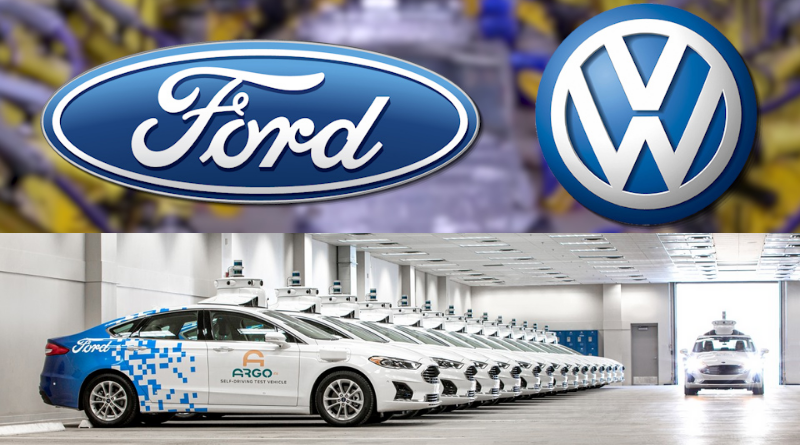
Back in July, Ford and Volkswagen announced they were taking things to the next level, expanding their “global alliance” to include tech company Argo AI in a shared vision for electric and autonomous vehicle development. Like many automakers, the two already had a small, project-oriented joint venture in the works, focused on creating electric work vans in Europe. But as the world sits on the precipice of a major industrial tipping point, it seems that these two friendly manufacturers have decided to work out an arranged marriage of sorts. One that allows them to remain competitive in the new dawn of EVs by sharing R&D costs and balancing out each other’s strengths and weaknesses. And while OE partnerships aren’t anything new, the Ford-VW alliance feels different.
Mainly because, it is.
“I think this is the beginning of a beautiful friendship.”
For perspective, let’s rewind a bit first—back to the Geneva Motor Show. We reported in March about the unexpected amount of strategic partnerships announced during that week’s festivities. At an event normally spent oohing and aahing over sleek new designs and groundbreaking vehicle technology, nervous execs spent an inordinate amount of press time lamenting the ballooning expenses associated with developing self-driving and battery-electric cars, emphasizing that the only way to survive this period of chaos is to buddy up.

However, for those who had been watching headlines, this likely didn’t come as a shocking surprise. In addition to existing alliances between Fiat and Chrysler, Ford and Tata, and Renault and Nissan, Honda and GM announced a new joint venture in late 2018 to tackle autonomous cars. Arch rivals BMW and Daimler entered into a $1.1 billion partnership to take on the likes of Uber two weeks before Geneva. And Toyota and Suzuki just tied the knot this last May to collaborate on new R&D. (Mazel!)
These pairings are just the tip of the iceberg, though. There are plenty more hookups quietly happening on the DL among OEs, tech start-ups, software companies, and battery manufacturers. And if you thought the aftermarket wasn’t adopting the same survival tactics—you haven’t been reading those press releases in your inbox.
How Much??
“Not everybody can afford to keep spending all this money, especially with how fast this innovation is coming,” said Don Walker, CEO of Magna International Inc., in an interview during the Geneva show. “There will be more cooperation, whether it’s through joint ventures or acquisitions.” Indeed, according to research data from AlixPartners, “Spending on autonomous vehicles, by traditional industry players and newcomers alike, is forecast to grow to a cumulative $85 billion through 2025.” That’s on top of electric vehicle costs.
VW alone has committed roughly 9 billion euros (~$10 billion) to EV development, as it aims to put 50 electric cars into production by 2025. Ford, who’s a little behind the curve, is investing $11 billion on its own EV venture, with plans to release an all-electric F-150 and a Mustang-inspired SUV, as well as several hybrids, in the next 1-2 years.
Which brings us back around to the budding Ford-VW alliance. If everyone is playing matchy-matchy, what makes this partnership different? Well, aside from being the largest of its kind in the industry, both automakers have taken some hits recently.
Misery Loves Company
Ford’s sales in Europe have been sliding for some time now, with the American manufacturer cutting jobs, closing factories, and eliminating vehicle models across the continent for the third time this decade. Throw in ever-tightening fuel emissions, a very expensive global restructuring program, as well as the Brexit debacle and, well, the Blue Oval has had a go of it. And Volkswagen? The Germans are still washing off the stink of Dieselgate—as well as coughing up money for fines and legal expenses.
And, so, like two wedding guests relegated to the “Awkward Singles” table, Ford and VW have peeled off into their own special little alliance. The terms of which are unique, in that each automaker “remains independent and fiercely competitive in the marketplace,” according to Ford CEO Jim Hackett. An agreement that he has dubbed “coopetition”—perhaps the most buzzwordy of corporate buzzwords to grace the new millennium.
A (Very Detailed) Arranged Marriage
“Folks, this is big news,” stated Hackett at a press conference in July. “Ford and VW could have partnered with anyone. But we both chose Argo. And together we’re on a path to create the industry’s leading autonomous vehicle platform.”
So, we know the players. And, we know the motives. But, what’s the endgame? And what are the terms of this Ford-VW alliance?
In 2023, Ford will introduce a new electric vehicle based on VW’s MEB platform and sell it in high volumes across Europe, with the potential for a second MEB-based model to come along later. (Remember—Ford is struggling to develop market share in Europe, and Volkswagen currently occupies about 25% of the space.) The ultimate goal is for Ford to deliver 600,000 MEB-based vehicles in Europe over a 6-year period.
In return, VW has promised to invest $2.6 billion into Argo AI, the Pittsburgh-based self-driving tech company that Ford has turned to for its autonomous software needs. Of that amount, $1 billion will be in actual funding, while the other $1.6 billion is the value of VW’s own self-driving division, Autonomous Intelligent Driving (AID) which will be jumping on board.
VW will also buy Argo AI shares from Ford for $500 million, over a three-year period. Ford will then invest the remaining $600 million it promised in its $1 billion cash commitment to Argo AI. This essentially makes Ford and VW equals in the investment into Argo AI. Argo will, in turn, set up vehicle testing in Europe. (It is currently in Pittsburgh, Palo Alto, Detroit, Miami, and D.C.)
Got all that? Good, because there’s more.
Ford will also work with VW to produce mid-size pickups. Namely, it will develop and build an all-new Ranger that will underpin the next-gen VW Amarok for customers in Europe, Africa, Middle East, Asia Pacific, and South America. It is possible VW will introduce a version of this pickup into the American market, as well.
Additionally, per the first round of the Ford-VW alliance from June 2018, the Blue Oval will build larger commercial vans for both companies beginning in 2022, destined for the European market. Ford will engineer a new full-size Transit van that VW will be able to rebrand into its future Transporter. In return, VW will build a city van—likely similar to the VW Caddy—that Ford can use for the European market.

However, despite this very detailed marriage contract, Ford and VW are allowed to see other people. In fact, Ford will continue its relationship with Rivian—in whom it invested $500 million back in April. Recent rumors suggest the two are currently developing an all-electric SUV on Rivian’s skateboard platform. Besides, Volkswagen plans to share its MEB platform with whoever is willing to pay up. In fact, Germany-based e.GO Mobile, the first partner to use the modular EV chassis, just started deliveries of its first model this past May.
Brave New World
Honestly, what makes the Ford-VW alliance unique is not so much the giant scale or the polyamory. It’s that even with an end result written on paper (X number of vehicles by Y date), there’s no real guarantee it’ll all go as planned. What makes it so different is the wildcard—the next-gen self-driving tech that doesn’t actually exist yet in a fully-formed, safe and sustainable state.
While everyone focuses on the big fish automakers, I can’t help but wonder about the little guy—Argo AI—as that company seems to be bearing the most pressure. Even with billions in cash and the best engineers available, what if Argo can’t perfect the autonomous technology in time?
Or, perhaps more frighteningly… what if they do?


