
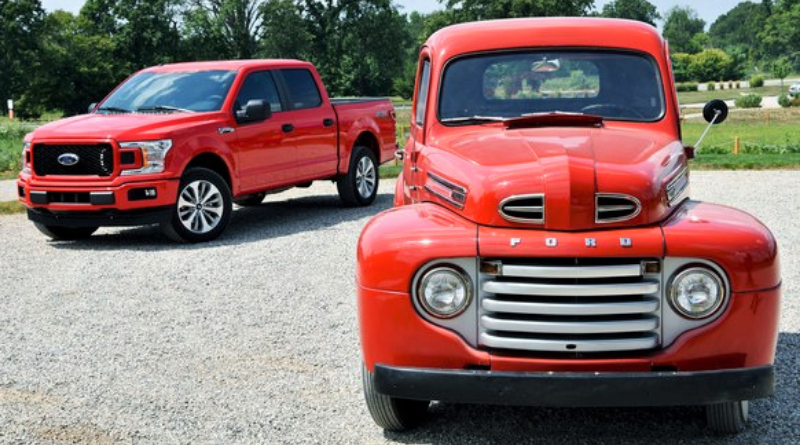
Future Trucks: Where are the BIG 3 Headed with Their Cash Cows?
As the market for SUVs and crossovers grows ever more crowded, OEMs turn to pickup trucks to boost profits—especially as the industry faces massive (and expensive) undertakings like electrification and autonomous driving. Check out our previous post on the Truck Wars to get a better picture of how we landed in this dynastic battle for crown pickup, as well as a rundown of some of the impressive innovations taking place in the segment. But since progress never pauses, read on to see what the Big 3—Ford, GM, and RAM—have planned for their future trucks, from exciting new technology to full-blown electric powertrains.
Let’s take a peek at what’s expected and see if we can’t place some bets on a future winner.
It’s Electric—Boogie woogie, woogie
Why not start with the obvious? Because, really, it’s impossible to talk about future trucks without talking *Future* trucks.
If you think electric engines have no place in your American pickup—think again. In addition to being cleaner and quieter, going electric has another advantage. Namely, one big hulking advantage: Torque.

Sure, plenty of powerful ICE and diesel engines produce massive torque low in their rev ranges. But it takes time to reach that from a stop. Since electric motors react quickly, that torque is immediate—and it doesn’t have to pass through multiple gears to get there. That means better acceleration and better tolerance of inclines and hills.
And, lighting a fire under the Big 3’s bumpers? Environmentalist groups, government-mandated fuel emissions standards, and some hefty competition from EV juggernaut Tesla and plucky newcomer Rivian. Both automakers will drop groundbreaking trucks in the near future, with a Tesla pickup concept expected later this year and Rivian’s production-ready R1T set to arrive by late-2020/early-2021.
FORD
Not to be outdone, America’s favorite truck manufacturer has jumped on the EV-train. An upcoming hybrid Ford F-150, based around a modified automatic transmission, will arrive next year and an all-electric model is slated to arrive shortly after that. It will most likely be based on the next-gen F-150 and will boast the performance, comfort, and styling we have come to expect from Ford, as well as impressive range and towing capacity.
FCA
In 2018, FCA announced big plans for new electric vehicles under its Jeep, Maserati, and Fiat brands—expected to manifest over the next 4 years. The automaker’s previous CEO, Sergio Marchionne, was loudly outspoken against EVs, which has halted the manufacturer’s progression. But, moving forward, current CEO Mike Manley has made it clear that “Fiat Chrysler will design future products to use a broad range of powertrains, from gas and diesel engines to mild, ‘conventional,’ and plug-in hybrids, as well as pure battery-electric drivetrains,” according to CNBC.

Expect to see these plug-in and all-electric powertrains crop up in Jeep and RAM models, as the latest Wrangler and 1500 pickup showed considerable success with their “mild-hybrid” technology. Less expensive than full hybrid systems, FCA’s eTorque saves on fuel use and emissions and improves performance and drivability—making it a nice gateway drug to alternative power in the pickup sphere.
GM
According to the Wall Street Journal, GM is scrapping hybrids altogether in the favor of going full-EV. “GM plans to launch 20 fully electric vehicles world-wide in the next four years, including plug-in models in the U.S. for the Chevy and Cadillac brands,” says the publication. A bold strategy that is—at least for now—confirmed to include an all-electric pickup. Although GM never comments on ongoing vehicle projects, both CEO Mary Barra and President Mark Reuss have dropped (decent-sized) breadcrumbs about future electric trucks.
Think Small
Who said only the big dogs get to have fun? Despite suffering a setback in the early ‘00s, mid-size trucks are back in consumer favor—and frankly, they’re looking better than ever! While the current craze to manufacture a truck for literally every potential type of consumer probably would have facilitated the small pickup’s return anyway, credit must be given where credit is due. The Toyota Tacoma not only survived the mid-size storm—it thrived. (Mostly thanks to the badass TRD.) And it’s safe to say that the Big 3 watched love blossom for the sweet little Taco and thought, “I’m gunna get me some of that.”

Capable and reliable, with impressive towing and payload capacities, plus nimbler handling and a less-shocking sticker price, mid-sizers offer a lot of potential to both interested consumers and profit-minded OEMs. But, as Edmunds points out, “Today’s smallest trucks aren’t very small at all. As many drivers have discovered, they’re really midsize trucks with near full-size proportions.”
So, uh, what if we go smaller?? While we likely won’t see a full return of the 80s-90s mini truck craze, several automakers have baby future pickups on the docket, including Hyundai, Volkswagen, and two of the Big 3.
FORD
In line with the automaker’s doubling-down on trucks and SUVs, Ford has confirmed both a Bronco pickup, and a Focus-based unibody truck slated to sit below the resurrected mid-size Ranger. Not much is known about the former, except that it should arrive sometime by 2024 and will compete with the Jeep Gladiator. Automobile Magazine predicts a four-door double cab model with the same 2.3L EcoBoost found in the Ranger, as well as a hybrid option, removable doors, and a reconfigurable top.
As far as the compact model is concerned, Ford’s president of global markets, Jim Farley, confirmed its existence back in January, saying that the automaker would be investing in “more affordable” truck options and that consumers should expect to see “new nameplates below where we compete today.”

Several outlets are predicting that should translate to a resurrection of the Courier nameplate, attached to a truck that’s “analog to the Transit Connect cargo and passenger van and will favor payload capacity over towing capabilities when it arrives in the early part of the decade,” according to Motor1.
FCA
RAM may not be ready to churn out compact future trucks, but that doesn’t mean it won’t try to get in on the mid-size game. Retiring the beloved Dakota in 2011, it has done an incredible job at revitalizing its full-size lineup, most recently outpacing Chevy for the #2 selling spot. The new RAM 1500 nabbed Motor Trend’s Truck of the Year award and the Jeep Gladiator debuted to near-rabid levels of fanfare. CEO Mike Manley is committed to welcoming an affordable mid-sizer to the lineup, claiming the lack of one is “a clear hole in our portfolio.”
Car & Driver predicts this new model will resurrect the Dakota name but be “closely related to the Jeep Gladiator,” riding on the same platform and using a 3.6-liter V-6. “The Dakota will likely be built at the same Toledo Assembly Complex as the Gladiator and Wrangler, using a modified version of the former’s steel frame,” says the publication. “Expect the Ram to drop the Gladiator’s live front axle in favor of an independent suspension.”
Anticipated arrival is late next year with a starting MSRP in the mid-$20,000’s.
GM
GM has held strong with its Canyon and Colorado, recently introducing a performance-variant of the latter—the ZR2 Bison. And, according to GM Authority, the automaker is developing a compact pickup as well, set to rival Ford’s new little hauler.

“The all-new model will be an indirect replacement for the Latin American-market Chevrolet Montana, which in some markets is named Chevy Tornado and Utility,” says the news forum. Currently in development exclusively by GM Brazil, it’s unlikely the little future truck will make its way to American shores. However, if Ford sees success in the compact realm, it’s safe to assume GM will look to capitalize on a shift in consumer taste.
Mixed Bag
Aside from revolutionary powertrains and a smaller footprint, what else can we expect to see from Big 3 future trucks? Well, the bigger-is-better attitude won’t simply disappear. Heavy-duty offerings are veritable cash cows for Detroit’s major players and will likely see some pointed updates over the next few years, despite all receiving major redesigns for 2020.
Additionally, cabin interiors will undoubtedly grow cushier, as consumers continue to demand more from OEMs. On that note, expect infotainment systems and connectivity options to get faster and flashier, as well—especially as 5G rolls out in the coming years. On-board safety features will expand too, likely sneaking into lower trims, as ADAS sensors become more commonplace and, in some cases, government-mandated.

It’s also safe to assume that, as the Big 3 sort out their investments in self-driving tech, various levels of vehicle autonomy will begin working their way into future truck trims. The question is: when we reach a point where traditional pickups operate themselves—do they become obsolete for everyday ownership? Why drive to Home Depot if the store can just dispense your materials to you, via a fleet of self-driving, all-electric F-150s? But that’s a topic for another day, and a future truck scenario we’d rather not entertain at the moment…
So, who are YOU betting will be the victor of the Truck Wars? Our money’s on Ford—as the automaker doesn’t seem eager to give up its best-selling crown, and its investments in electrification and future tech are smart and measured. But we can’t deny FCA plays an aggressive game and GM has a reputation for being the Comeback Kid.
Let us know your thoughts in the comments below!


