
Industry Recap: 2021 Auto Sales Totals and 2022 Predictions
If you’re looking at the start of 2022 and thinking, ‘Meet the new year… just like the old year’ you are not alone. Despite news of an “ongoing recovery,” economists and industry experts are being particularly careful with their market predictions, doling out statements more noncommittal than a fortune cookie.
… “U.S. light-vehicle sales and North American production are expected to rebound in 2022 and 2023, but supply-chain problems and the resulting new-vehicle shortage are predicted to persist at least through next year. [Actually], it could take until 2024 or even 2025 for the auto industry to satisfy pent-up demand and fully rebuild new-vehicle inventories.”
… “We believe the auto business is in for a healthy year. Yes, there will be unexpected pitfalls, but those who remain flexible and agile will manage just fine in the year ahead.”
… “Automakers have their hands full.”
… “In the middle of every difficulty lies opportunity.”
Alright, that last one is from an actual fortune cookie but the point remains: 2020 proved how foolish it is to try and predict the future. In the midst of a lingering pandemic, with bloated and sluggish supply chains taking their toll on American retail markets, no one is jumping at the chance to play confident optimist.
“My gut tells me things are going to get better and may not be as bad as they seem,” Jamie Butters wrote for Automotive News. “But at the moment, it looks more like a road to hell.”

Economics 101: Supply & Demand
Year-end totals place 2021 U.S. auto sales just under 15 million units, an incremental bump from 2020’s dismal numbers but way below recorded five-year averages of about 17 million. Interestingly, fourth quarter total new-vehicle sales put up a weak fight, posting numbers significantly lower than their 2020 counterparts. J.D. Power and LMC Automotive reported a 19.9% decrease, blaming low inventory supply and high consumer demand.
Luxury vehicle sales however, did not have such a disappointing quarter. “December typically is the best month for [these] sales, and 2021 followed that trend in a big way,” said Kayla Reynolds, Cox Automotive analyst. “The result was another record in overall average transaction prices, completely driven in December by the increase in luxury vehicle sales.”
Reynolds placed the boujee segment’s sales at 18.4% of total sales in December 2021 and estimated luxury buyers paid, on average, $64,864 for a new vehicle – a “record-setting sum more than $1,300 above sticker price.” (For comparison, luxury vehicles were selling for more than $3,000 under MSRP one year ago, she added.) As for non-luxury folks, they doled out an average price of $43,072 for a new ride. Cox Automotive said this price is slightly down from November record highs, but is still $900+ over sticker.

Altogether, Kelley Blue Book placed the average price Americans paid for a new car at more than $47,000. The record high number marks a whopping increase of $6,220 since last year. Again, analysts point to low supply and high demand, citing stressors like COVID shutdowns, staffing issues, and perhaps most impactful – the lingering semiconductor shortage.
Chip Dip
While several headlines dominated auto industry news reports during 2021, the most pervasive seemed to be the global microchip shortage. Microchips or semiconductors are tiny processors essential to nearly all modern vehicle technologies, from power steering and brake sensing to back-up cameras and dashboard touchscreens.
When COVID shutdowns spurred a work-from-home and learn-from-home culture, purchases of microchip-laden electronics skyrocketed. Global supply dwindled quickly and, with factories closed or on limited operation, rebuilding inventory has been slow-going.
According to Automotive News, the low supply caused manufacturers to cut an eye-watering 10.2 million vehicles from their production plans in 2021. Looking ahead, the publication expects U.S. auto sales to climb just 3.4% this year as a result.
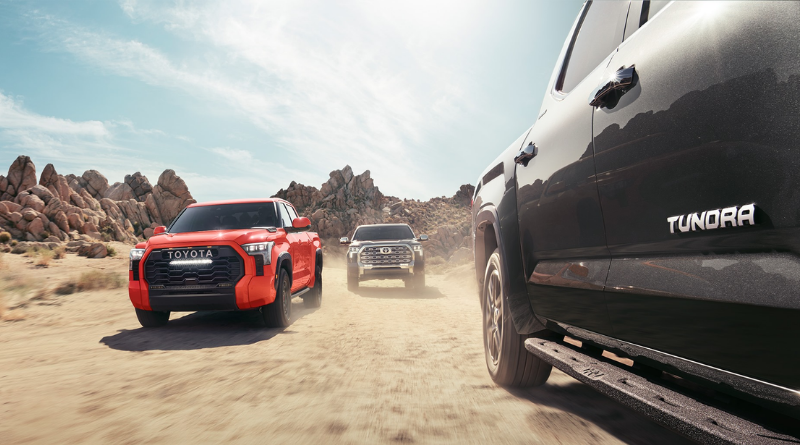
One automaker who learned some savvy inventory management in 2021 was Toyota. The Japanese brand became America’s top-selling automaker for the year, knocking General Motors off its throne for the first time in nine decades. The victory also marks the first time a non-domestic automaker took the top spot in America.

The semiconductor shortage precipitated a lot of the market changes seen in 2021, many of which are expected to linger in 2022. Keep reading to learn what’s different and how we here at The Engine Block (cautiously) predict these changes might play out in the year ahead.
Historically Low Inventory, Resilient Consumer Demand
As mentioned, automakers have been hard-pressed to bump up vehicle production without the necessary raw materials. Cox Automotive reported the auto industry had only about 1 million new vehicles on dealer lots in December, which was 1.8 million fewer new vehicles available for customers to buy in 2021.
However, demand remains high despite rising inflation. According to J.D. Power, retailers are selling vehicles almost as soon as they arrive in inventory. “The average number of days a new vehicle sits on a dealer lot before being sold is on pace to fall to 17 days, a record low and down from 49 days a year ago,” said Thomas King, president of the data and analytics division. He also noted a new record for December: nearly 57% of vehicles were expected to be sold within just 10 days of landing on dealer lots.
Prediction? Taking a cue from Ford, we expect to see more automakers exploring build-to-order models for their upcoming inventory management strategies. The Blue Oval’s CEO Jim Farley criticized the industry’s current go-to-market system as unnecessarily complicated, and pledged to operate with tighter inventories moving forward. He said targeting a 50-day supply (rather than 75 days or more) and switching to a more “order-based” system not only helps Ford better manage its production, but also ensures higher margins for the automaker as well as its dealers. Less hassle + more money = safe bet.

Sky-High Pricing
Rising alongside those record average transaction prices (again, $47,000+!) are auto loan interest rates. While the national average for a 60-month new auto loan in 2021 remained fair – starting the year at 4.24% and ending at 3.92%, according to Bankrate data – those low rates can’t hold on much longer.
“Inflation is at the highest level since 1982, and the Federal Reserve Bank is ready to address that with expectations for three, quarter-point rate increases in 2022, followed by three in 2023, and two more in 2024,” warns Cox Automotive analysts. They anticipate a gradual increase in auto loan rates by the end of this year, but feel the average will still be “attractive.”
Auto insurance rates are also on the rise. Insurify estimates a 12% jump 2021 and predicts another 5% increase in 2022. Inflation is only partly to blame here, thanks to a record high traffic fatality rate that remained 26% higher in 2021 than it was during the same period in 2019.

Prediction? With automakers planning to keep vehicle stocks low and consumer demand staying high, it is unlikely prices will come down anytime soon. As a result, we expect a few things.
First, the light truck segment will keep its crown. Modern SUVs and pickups undeniably deliver excellent bang-for-your-buck, especially as automakers pump out off-road-ready variants that can hit the trails with the same confidence they roam the grocery store parking lot. Second, we expect higher prices to improve leasing demand. Low auto loan rates coupled with poor automaker incentives hurt the financial trend the last few years. We expect it will see a rebound as consumers look for any and all ways to bring down their new-car monthly payments.
Flaming Hot Used Market
Wholesale used vehicle values finally showed some signs of cooling down at the end of 2021, but retail used-vehicle prices keep on climbing. Cox Automotive reported the average list price is now approaching a record high of $28,000. Edmunds predicts that number will surpass the $30k mark for the first time this year.
While many Americans are still seeking new and new-to-them vehicles, many more are perfectly content to love the one they’re with. In June, IHS Markit reported the average age of light vehicles in operation in the U.S. hit a new record of 12.1 years. This spells good news for the aftermarket, which will thrive on vehicle owners’ maintenance needs and customization wants.
Prediction? According to KPMG, used-vehicle prices are up a whopping 42% over January 2020 levels, while new-vehicle prices have only risen about 12%. Some semblance of pricing equilibrium will return, the consulting firm said, but that will require a 20-30% plunge in used-vehicle prices. Unfortunately, that means many customers could find themselves saddled with some negative equity. Other forecasters, like Cox Automotive, expect a less dramatic return to normal depreciation. Either way, expect those sky-high values to come back down to earth.

Team: Assemble
Over the past few years, it’s been almost impossible to open one’s email and not be met by news of a major SPAC, merger, or acquisition. Electric vehicle start-ups, in particular, have adopted this path to going public. Lucid, Fisker, Canoo, Lordstown Motors, and Faraday Future are just some of the recent EV-makers who merged with SPACs – sometimes called “blank check” companies – in order to ensure they live another day.
According to data from SPACInsider, in 2007, just 66 SPACs, across industries, went public. The strategy picked up steam in 2019, but reached “a fever pitch” in 2021 when 489 SPACs listed publicly, said Retail Dive. However, many of these companies withdrew their SEC registrations during the first three weeks of 2022. Financial Times suggests investors may be losing their appetites amid “poor performance, high-profile scandals, and regulatory scrutiny.”
Prediction? With the feds pushing for stricter rules around SPACs, we expect the trend to cool. However, we do not imagine more traditional mergers and acquisitions will be slowing down anytime soon. Supply chains remain nightmarish, labor shortages grow tighter, and it’s anybody’s guess what fresh hell tomorrow’s COVID variant will bring. Retailers will continue to join forces in the hopes of shoring up reserves. That remains true for the aftermarket too, so expect more collaboration from your favorite brands. Some big aftermarket team assemblies in 2021 included PerTronix and Aeromotive, Cooper Tire and Goodyear, and Fabtech and WARN.
Electric Wave
Perhaps the least surprising change, trend, and prediction on this list pertains to electric vehicles. Those who pay even the slightest attention to the auto industry are aware of EVs dominating automotive activity.

Edmunds analysts estimate that U.S. EV market share will climb to 4% (4.6% retail) in 2022, eclipsing 600,000 units for the first time. And automakers seem determined to help that prediction come true, pushing an impressive number of EVs to market. Bank of America’s annual Car Wars report expects OEMs to launch 240 new models during 2022-2025. Of those, it anticipates more than 60% will sport an alternative powertrain.
Despite the gold rush mentality, there remains a lot of lingering uncertainty on the market. For example, ZF Group, the world’s third largest parts supplier, anticipates EV production accounting for about 45% of global vehicle output by 2030, with EVs representing 49% of all vehicles assembled in North America. But Magna, the world’s fourth largest supplier, puts that number at a mere 20%, with the U.S. coming in below the global average. That’s a big difference, and illustrates how difficult it is to pinpoint any honest predictions when important issues like cost, availability, and charging infrastructure will likely determine any true rate of success.
Prediction? Regardless of adoption rates, one thing is for certain: EV-curious folks will have plenty to peruse when shopping – particularly in the pickup segment. A number of new entrants are joining the crowd, including the Rivian R1T, GMC Hummer EV, and Tesla Cybertruck. We expect all of these vehicles to drum up lots of marketing buzz, but perhaps none as much as the Ford F-150 Lightning. With nearly 200,000 reservations already racked up, we see this model being just as successful as its ICE counterpart.


