
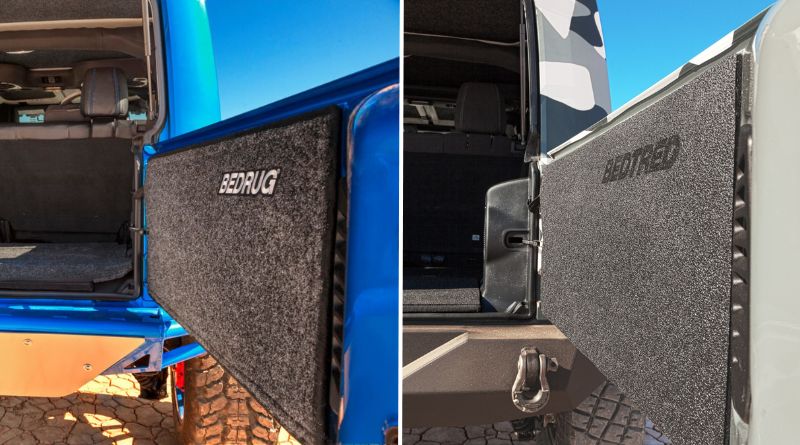
Interior Jeep Protection: BedRug vs BedTred
If you’re in the pickup truck space, there’s a pretty good chance you’ve heard the name BedRug. They’ve been a staple in the truck bed lining space for decades.
At first glance, their flagship product (of the same name) may seem like a curious choice to line a bed with. Truck guys and gals are generally considered rough and tumble folks who are always talking about Line-X this, and Rhino Lining that. They love themselves a gritty, durable, spray-in bed liner that can stand up to anything. Not a… carpet.
In a past article, we looked at how a BedRug is actually a great (and even superior) option for a vast number of truck owners. But there’s an application that this author thinks are even better options for BedRug—Jeeps!
Wrangler owners are rugged, outdoorsy people too, but they aren’t hauling a ton of rocks or sand for landscaping jobs. They can benefit from the comfort a BedRug kit provides. (Heck, it’s why most OEM Jeeps themselves are carpeted.)
But BedRug isn’t just plain ol’ carpet. It’s a technical marvel that’s 100% waterproof and resistant to stains and mildew. Along with its sibling, BedTred, the BedRug products provide the ultimate in comfort, durability, and longevity.

BedRug vs. BedTred
So, you’ve decided to line your Jeep with a BedRug product—good choice! But now another decision must be made: Do you want to opt for the traditional BedRug, or go for the spray-in liner look of the BedTred?
While there certainly some feel, texture, and appearance differences between the two, we’d say they’re actually more alike than different. Both offer the same water/mold/mildew resistance, insulation benefits, and easy cleanability.
The BedRug is made from a carpet-like polypropylene, while the BedTred uses a Thermoplastic Olefin (TPO)—both having superior heat and chemical resistance.
The BedRug’s light gray appearance contrasts with BedTred’s darker gray color. And while the BedTred surface is certainly not abrasive, it does have a bit more grit to it, making it slightly better at keeping items in place.
Although the BedRug isn’t as plush as a shag carpet (that’s a good thing), it does offer a softer, more inviting liner choice in our opinion, especially for the cabin of a Jeep. If you do a lot of tailgating, camping, or overlanding with your Jeep as home base, the softer texture may prove a better choice.
One last thing we’ll point out, is that the Venn diagram of Jeep and dog owners overlaps quite a bit, and animal owners know the trials of cleaning hair out of fabric. While the BedRug cleans up well with a nice vacuum, dog owners will find it a bit more tedious to clean than the BedTred. (As dog owners, we found hitting the BedTred with a quick leaf blower works like a charm.)
How to Install
Installing a BedRug or BedTred kit/component in your Wrangler couldn’t be simpler.
Firstly, if your Jeep has existing carpeting or material, you’ll want to remove it. Now, you can certainly do it the bull-in-a-fine-china shop way and take a box cutter to hack it up. But you’re a bit more civilized, aren’t you?
We recommend doing it carefully for a couple reasons. Firstly, if your original Jeep carpet is in decent condition, list it on a marketplace like eBay. It’s amazing what these used OEM kits—even in meh condition—can still go for. (In fact, you can recoup quite a big chunk of your new BedRug purchase.) And if you ever want to sell your Jeep or need to put old flooring back it, you’ll be glad you didn’t hack and slash your old carpet.

There are numerous videos and tutorials online for whatever Jeep model you have that explain every fold, tuck, and bolt that hold your factory flooring in place. Follow them and you should have no problem taking out that old carpet in full pieces.
Once it’s out, to ensure a solid, flush, and secure fit, wash out any dirt or debris from the area you’ll be mounting it to. You can do this section-by section or use the floor drain plugs and hose ‘er down all at once.
Once it’s all dry, use the included hook and loop (Velcro) to mount your BedRug, making sure to include the heat shielding as well. It’s as simple as that! No messy adhesive or drilling required!
How To Clean/Maintain
One of the many great things about a BedRug liner – quite possibly the best – is its resistance to staining and super-simple maintenance.
If you’ve got young kids, or are a bit clumsy yourself, you probably know that it’s tempting fate to bring a nice carpet or fabric couch into your home. Juice, art supplies, food (mommy’s wine, perhaps?), they all can do major damage to household cloth—especially if left to set.
BedRug eliminates that danger inside your Jeep. While it may look like ordinary carpet to the untrained eye, BedRug/BedTred’s composite surface resists stains from most acids, chemicals, oils, and more. Plus, the foam backing will not absorb liquids, ensuring you don’t get mold, mildew, or that awful wet dog smell.
To keep your BedRug looking fresh, a broom, brush, vacuum, or compressed air can be used to remove dirt and grime. And since liquid dries quickly and won’t seep through to your floor, pressure washing is also a great way to clean a soiled BedRug.
While most acids won’t harm your BedRug, we recommend using a little baking soda to neutralize any harsh chemicals. For tougher jobs and caked-on dirt, a mild detergent can be used with degreaser and water. Most DIY car washes have this available—so you can wash the inside and outside of your Jeep all at once.

About Bedrug
As a Jeeper and off-roader, you and the companies you support should support sustainable and nature-friendly practices. BedRug is one of those environmentally-conscious companies. Their products are made from fully recyclable TPO/polypropylene composite. All of their unusable materials are recycled into pellets, which then get used in a wide variety of goods. Bedrug does not use any prohibited or declarable substances on the Global Automotive Declarable Substance List.
To learn more about BedRug (and BedTred) head over to https://bedrug.com/


