
Selecting the Best Wheels and Tires for Your Overlanding Build
Today we’re taking a look at wheels and tires, a common area of critique on an overlanding rig. While you’re reading this post – and especially when you’re making eventual decisions – we ask that you block out everything you hear from others and everything you see on Instagram.
Start with one basic thought. Do you even need to upgrade?
This is the first and perhaps, biggest question of all. Not just for overlanding wheels and tires, but really for anything aftermarket. Along with this simple question, ask yourself a few other questions about the build you want/already have. And be honest, straightforward, and truthful with yourself when answering.
- Is it a need? A want? An eventual goal?
- Do I have the financial resources to comfortably make this purchase?
- Will this purchase affect my ability to buy other necessary upgrades?
- How much benefit will I see from making this upgrade?
- What kind of future costs will be incurred from purchasing what I’m looking at now?

Consider Your Budget & Be Realistic
Not to get all Dave Ramsey, but no matter what your financial status, sticking to a plan and budget will ensure the best outcome for you and your overlanding build. Overlanding equipment tends to be pretty expensive stuff, and other than your vehicle itself, a complete wheel, tire, and possible suspension upgrade will be the costliest investment you’ll likely make.
Does it make sense to buy several thousand dollars in knobby tires if you’ll be primarily driving on well-maintained access roads? If this vehicle doubles as your daily driver, will an aggressive upgrade make your commute unbearable? Are there more pressing accessories that need to be purchased such as a tent, winch, and recovery tools?
In this social media era, where people feel the need to keep up with their favorite influencer, these are questions that need to be asked – and answered without any traces of envy or jealously. If the answers you come up with still point toward replacing what you have, then we can help narrow down that decision.
Here are a few things to consider when making a change to the shoes and socks of your vehicle.

Tires
Depending on who you ask, some builders will let tire size dictate what suspension they can use. Others will spec out a suspension/lift kit first, and then consider appropriate tires. Whichever one of these scenarios is you, make sure both your suspension and tire size are compatible.
Most overlanding upgrade wish lists will include a larger tire size, but that doesn’t always need to be the case. Perhaps your vehicle already has beefier tires – whether it be an aftermarket upgrade, or a higher end off-road trim level. Or, maybe you just don’t see the need for anything larger and want to keep current driving dynamics.
If you are comfortable with the size you have now, don’t feel pressured into getting something larger just because it’s the common thing to do. Like we said in the opening, stick to your budget. If more pressing parts on your rig need to be purchased or upgraded, go there first.

For example, my own rig came with an off-road trim package outfitted with 265/75/16 tires – or about 31.5″. I did a lot of research, forum scouring, and question asking before deciding that I would – and could – fit a bit larger tire when the time came to replace them. I went with 33″ tires and have been completely happy with the choice, and am on my second set.
Are they as “cool” as 35″s or 37″s? Not in the eyes of some, but they suit me perfectly, give me the performance I crave, and allow me to not have to change much in my suspension, gearing, and body modification. Speaking of which, let’s go through a few pros and cons of upgrading tire size.

Pros & Cons of Bigger Tires
Pros:
- Increase overall ground clearance
- Improved approach, departure, and breakover angles
- Improved ‘floatation’ when aired down, or ability to stay on top of softer ground surfaces
- More surface area for better gripping
- Aired down larger tires can provide a softer ride
Cons:
- Decreased fuel economy
- Additional suspension upgrades may be needed to fit and operate tires optimally
- Body/panel/wheel well/fender modification may be required even after proper suspension upgrades
- Bigger tires will negatively affect turning radius
- Poorer on-road driving manners, including increased road noise
- The possibility of an upgrade to your spare mounting situation may be needed
- More expensive and, depending on the size, may be less selection/availability
Choosing Tread/Terrain
Once you’ve dialed in your sizing, there still is the matter of what tread/terrain tire to choose. Generally speaking, your choice will probably be between an All-Terrain or Mud Terrain tire. To make the choice between these two, be realistic about what kind of ground you will most likely be tackling.

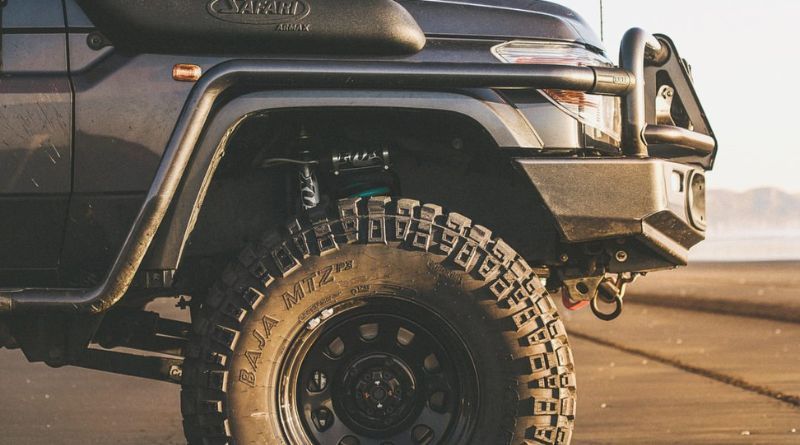
If you heavily dabble in the off-road sector, and plan to consistently travel off the beaten path, then perhaps you’ll benefit from the aggressive nature of a mud terrain. These tires feature large, thick, knobby treads that offer the maximum traction in extreme terrain. Sure, they perform (and look) the best, but that does come with several downsides. Compared to their contemporaries, they’re heavier, louder, less-efficient, more expensive, and wear quicker. But if you need the performance, love the look, and have the cash, nothing beats them.
For the rest of us, an all-terrain tire is a more sensible choice. It’s lighter and quieter than a mud terrain, while still offering good traction and performance. All terrains also offer better fuel economy and are cheaper to replace. They still offer an aggressive look and since they’re a more popular style, you’ll have more options and sizes to choose from when shopping.
We do have to mention the rise of the rugged-terrain tire, as well. This is a tweener option that slots right between all-terrain and mud terrain.

The category didn’t really exist 15 years ago, but over the past several years manufacturers have seen the want for a middle option that bridges the gap between the two types. If you plan on trudging over and through a variety of terrain, including more challenging territory, but still want something a bit more mild-mannered and hard-wearing, a rugged-terrain may be the option for you.
Wheels
While some may view wheels as a no-frills necessity that are just there to wrap a tire to, they are a great way of adding personality to your overlanding build. But it’s not just aesthetics; there are some wheel choices you’ll need to make that can greatly affect the overall performance of your rig.
Not to beat a dead horse, but once again, consider the stock wheels that are already on your vehicle. Is there anything inherently wrong with them? Do you need to replace them?
Stock wheels are often one of the best choices – or non-choices – that you can make. They’ve been tested extensively from the vehicle manufacturer, are built to spec, are probably more readily available, and often have some of the best fit and finish on the market. If the choice of your suspension and tires falls in line with the wheel you already have, why make a change? (Especially if you’re tight on funds.)

But we get it. Maybe you hate the look, want to switch things up, or a different wheel is necessary for your build. In that case here are some things you’ll need to consider:
Sizing
We’re not building a show truck, so a massive bump in wheel size shouldn’t be in the cards for your rig. Eighteen inches is probably the maximum we’d go for an overlanding rig, and a 16″ or 17″ size is more in our wheelhouse.
The all/mud terrain tire options are plentiful in this range, and while these sizes may sound small to someone accustomed to watching Pimp My Ride, it’s the best choice. A 15″-17″ wheel size will allow us to strap a tire with a much beefier sidewall to it, allowing for better performance and grip overall, especially when aired down.
Material—Steel vs. Aluminum
It’s the aftermarket bumper debate all over again. Should we choose steel or aluminum? Steel wheels are cheap and plentiful, but aluminum is lighter and often much better-looking. Aluminum can experience corrosion, but it’s not nearly as bad as the rust issue many steel wheels face.

We can’t say one is hands down better than the other. Some like the utilitarian look of a good set of steelies; some like the more modern look of aluminum. It’s up to your taste and wallet.
Beadlocks?
A beadlock tire may make sense for a seasoned off-roader who often finds themselves airing down their tires quite a bit, both in frequency and PSI. Beadlock wheels will ensure you can air down your tires to extreme levels (single digit PSI) to gain more tire to ground contact, without needing to worry about tire slippage.
The bottom line is that the vast majority of overlanders won’t need this nicety, nor the extra weight, cost, and maintenance they offer. If you like the look of a beadlock wheel, however, consider opting for one with simulated beadlocks. We won’t tell anyone they’re not genuine.
Keep these tips in mind when considering aftermarket upgrades, and embark on your next overlanding expedition fully equipped with the ideal wheels and tires.


