
Seven Tips and Tricks for Improving Your Truck’s Gas Mileage
Tips to improve your truck’s gas mileage, from simple maintenance tasks to advanced modifications.
We all love the power and versatility of our trucks, but let’s face it, the gas mileage can leave something to be desired. Thankfully, there are several steps you can take to squeeze a few more miles out of each gallon – and many of them are just simple tweaks to your daily routine.
So, hop in, buckle up, and get ready to maximize those MPGs. Here are seven tips and tricks to improve your truck’s gas mileage so you can go farther for cheaper.
Check Tire PSI

One of the easiest and most effective ways to improve your truck’s gas mileage is by keeping your tires properly inflated. Underinflated tires create more rolling resistance, which means your engine has to work harder to move the vehicle.
Regularly check your tire pressure using a reliable pressure gauge and ensure that it matches the recommended levels specified by your truck’s manufacturer. Your truck tire’s PSI (pounds of air per square inch) can be found on a sticker in your driver’s side doorjamb, or in your owner’s manual. This PSI is what you should be inflating your tires too, not necessarily the PSI number on the tire.
While TPMS (Tire Pressure Monitoring Systems) have taken over in most vehicles, it’s still important to manually check your truck’s tires at least once a month, and especially before heading out on a long trip or when carrying or towing heavier loads.
Hot Tip: The best time to manually check your tire’s PSI is in the morning before you’ve driven your truck, as cool tires will provide a more accurate reading.
Cut Down on Idling

You’ve probably heard the myth that turning off your vehicle and starting it back up wastes more gas than just letting it idle. But it turns out that idling actually wastes more gas than starting and stopping your vehicle when in heavy traffic or at long traffic lights.
Many modern vehicles now employ start-stop systems, but if yours doesn’t, consider turning off the engine if you anticipate being stationary for more than a minute – like when you’re waiting at the drive-thru or hanging out in the parking lot for an extended period of time.
Planning your routes ahead of time to intentionally avoid heavy traffic and construction zones can help you cut down on idling (and save some travel time, too). Consider using a navigation app like Waze that offers real-time traffic updates and auto-suggests the most efficient routes.
Keep the Tailgate Up

Another myth about improving gas mileage is that keeping your truck’s tailgate down will improve aerodynamics and ultimately gas mileage. In actuality, driving with the tailgate down actually increases drag and hurts your gas mileage.
The science behind it is pretty interesting. A closed tailgate sets up a bubble of air that slowly circulates in the bed of the truck. Air coming over the cab of the truck treats the bubble as a smooth cover over the bed and passes over this ‘cover’ without ramming into the tailgate. When you open the tailgate, you break the smooth bubble of air.
Conduct Regular Maintenance

Obvious, but worth mentioning is that the regular maintenance of your vehicle is so important to fuel economy! Routine tasks like oil changes, spark plug inspections, and air and fuel filter replacements help keep your engine in good health, so it can operate at its best and run more efficiently. Make sure to follow the manufacturer’s recommended maintenance schedule and address any issues promptly.
Additionally, (and especially if you operate an older ride with poor fuel economy), consider switching to a high-quality synthetic oil. Synthetic oils have better lubricating properties, reduce friction, and offer improved resistance to heat and breakdown. This can lead to smoother engine operation, less wear and tear, and improved fuel efficiency.
Try a Tuner Upgrade

Tuner upgrades can have a significant impact on both engine performance and fuel economy. (A tuner is a device or software that modifies the engine’s computer system to optimize various parameters such as air-fuel mixture, ignition timing, and boost pressure.)
By fine-tuning the engine’s parameters, tuners can enhance power output and torque, resulting in better acceleration, combustion, and overall performance – which generally leads to better fuel economy. However, the extent of the improvement will depend on the vehicle, driving conditions, and what kind of specific tuning mods you’re getting into.
For example, there are tunes specifically engineered to improve gas mileage, but you may sacrifice some performance capabilities to gain those additional MPGs. That’s why it’s important that tuner upgrades be performed by knowledgeable and experienced professionals or reputable tuning companies that can help you strike the right balance. Improper calibrations can have some nasty side effects on engine reliability or emissions compliance.
Upgrade Your Exhaust

Various factors affect fuel economy, from driving habits and vehicle condition, to aerodynamics and combustion efficiency. And while upgrading your truck’s exhaust system isn’t guaranteed to make a big impact on its own, when performed in tandem with the other tips on this list, it can certainly help.
A custom or upgraded exhaust system essentially helps your engine breathe better. This can result in improved combustion efficiency and power output, leading to less fuel consumption. (And it definitely results in a better exhaust note.)
Like with tuners, it’s wise to consult a professional when choosing an exhaust system to ensure you’re getting a setup that matches your specific performance and efficiency requirements.
Install a Tonneau Cover

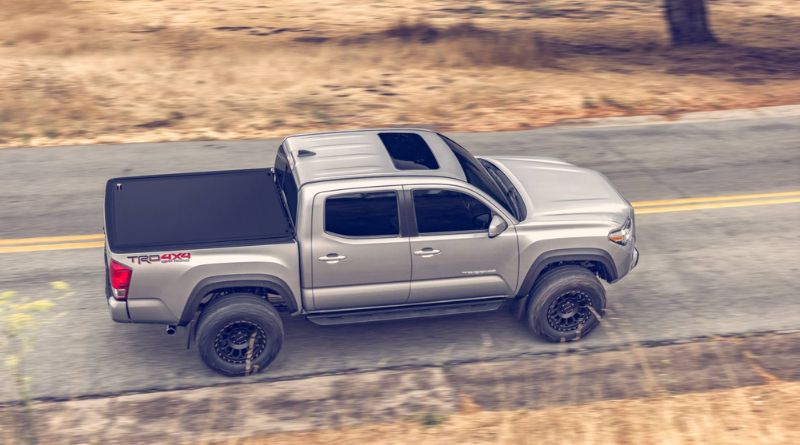
Installing a tonneau cover takes streamlining your truck to another level. A tonneau cover greatly increases your truck’s ability for airflow to go right over the truck bed and results in improved aerodynamics.
In fact, according to a Wind Tunnel Study conducted by SEMA, driving with a tonneau cover delivered an average 5.7% reduction in drag. As it relates to the pump price, that’s about a 1.8% increase in fuel efficiency.
Besides, adding a tonneau cover has a host of other great benefits too. A secure cover not only keeps cargo safe, dry and protected, but the truck bed as well. Extreme temperatures and rough weather can really take a toll on that exposed area, chipping away at the bed’s paint, durability and metal construction. A tonneau cover can help limit those maintenance and repair costs, while also preserving your truck’s resale value.
Sponsored by BAK Industries

As the manufacturer of America’s #1 selling hard folding cover and America’s #1 selling hard rolling cover, it’s safe to say BAK knows a thing or two about manufacturing a quality tonneau. The company is a heavyweight in the truck accessories market, and offers multiple cover styles to suit a variety of truck owners. Better yet, BAK’s products play nice with many other aftermarket accessories, like cargo and bike racks, which are essential to creating a truly customized setup.
One such stellar offering is the new-and-improved Revolver X4s. Introduced in 2021, the X4s has been reengineered to improve installation, use, and longevity. The result is a truly fantastic hard rolling cover at an exceptionally fair price point.

To learn more about the BAK Revolver X4s, visit https://bakindustries.com/ or check out our in-depth coverage on the model HERE.


