
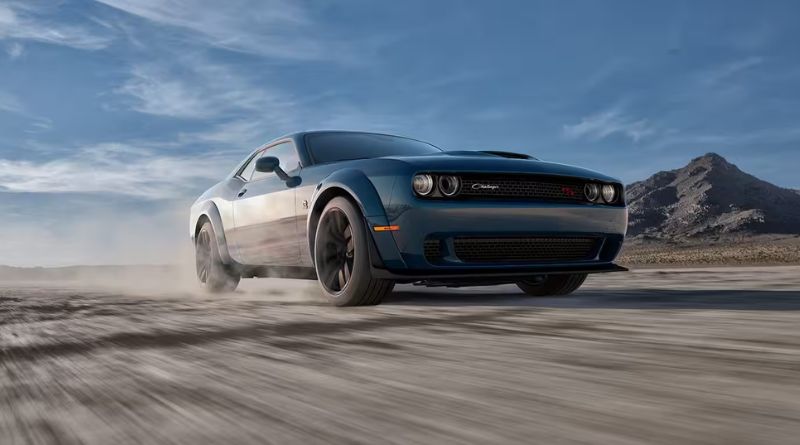
A Shocking Murder Mystery: The Death Of The Muscle Car
The age of the gasoline-powered performance coupe is nearly over. Blame is flying, but where does it ultimately land?
By January 2024, the Ford Mustang will be the last gasoline-powered Big 3 muscle car in production. The Chevy Camaro’s production line will shut down that month and both the Dodge Charger and Challenger are scheduled to end production in December of this year.
Enthusiasts are struggling to come to grips with a future devoid of bellowing V8s, and are laying blame on anything with a flat surface. If there always has been and always will be an appetite for performance, how have we gotten to the point that the muscle car demise is now inevitable?
What defines a muscle car?

Let’s start right off with the controversy. The first muscle car was created in 1949 when Oldsmobile installed a 300 cubic inch V8 into a smaller platform car creating the Rocket 88.
Or was it…?
In 1955 Chrysler sold its C-300 with a Hemi allowing it to hit 60 mph in 9.8 seconds. I can give you a dozen other examples, but really, the first muscle car had to be the 1964 GTO – right?
Let’s call them fast, front-engine, rear wheel drive, American cars. For the purpose of this article, we’re referring to the last modern muscle cars in existence: the Chevy Camaro, the Dodge Charger and Challenger, and the Ford Mustang.
Some say the 4-door Charger isn’t a real muscle car. Some will point out that the Mustang and Camaro are actually pony cars. If you don’t like it, stop now because it ain’t getting less controversial.

What is killing muscle cars?
I am responsible for killing muscle cars; not just me, but millions of people like me. There are many opinions on why Chevy and Dodge are ending production of historic fan favorites. Some of them have merit. Others are little more than rhetoric feeding our already toxic tribalism.
Spoiler alert: It’s not fuel economy standards and environmentalists.
Let’s go back a few years. The first Corporate Average Fuel Economy, or CAFE Standards were enacted in 1975 in response to the 1973 Oil Embargo. They were blanket regulations, requiring all passenger vehicles sold by a manufacturer for the U.S. market to hit a minimum MPG. The CAFE requirement would be increased year over year, but it’s worth pointing out, the industry easily surpassed the MPG requirements every year. As gas prices fell, so did the interest in fuel economy standards. They were largely ignored until the Bush administration took an interest in 2005.

The Energy Independence and Security Act, EISA established new CAFE standards for the US market. The new regulations set different requirements for passenger cars built domestically versus imported. Domestically-built vehicles were required to meet a corporate average of 27.5 MPG by 2020, while imported cars were required to hit 35 MPG by 2011.
While this sounds like a gift to American manufacturers, the car business had become global and many American cars either had been or were scheduled to be built somewhere else.
Did your Charger, Challenger, or Camaro come from Canada? Did your neighbor’s Accord or Camry come from Kentucky or Ohio? Not only were the new regulations not a leg-up for domestic car builders, but they favored companies who already had a bigger portfolio of smaller, fuel-efficient models.

Roll-backs and rule changes actually helped the segment.
One of the first things the Obama administration did in 2009 was to roll back CAFE standards slightly. But more importantly, it rewrote how they were calculated.
The new regulations weren’t a straight average of MPG of all vehicles. Instead, the required fuel economy used a sliding scale based on a vehicle’s footprint — wheelbase multiplied by track-width — with larger vehicles having lower MPG requirements. This not only favored American manufacturers in general, it also favored muscle cars.
A low and wide muscle car has a footprint larger than a typical import sedan, but could also be designed to be lighter and more aerodynamic. This would have made muscle cars (especially the smaller engine, bigger sales volume models) more attractive to manufacturers to keep producing.
Trouble is, nobody wants them.
Sadly, it was right around this time that Americans, consumers and producers started losing interest in normal passenger cars.

Manufacturers discovered that starting with a run-of-the-mill hatchback, lifting and stretching it a little, and then adding some plastic cladding was a guaranteed recipe for big profits. Muscle cars, which rely on selling huge numbers of base models at discounted fleet prices, are not so profitable.
Suddenly, the demographic that loved being in the driver’s seat of a V6 coupe — either buying it with the paycheck from their first real job or renting it at the Avis counter at the Las Vegas airport — were demanding crossover vehicles instead. As a result, 2015 became the last real hurrah for muscle cars, while CUVs hit the gas and pulled away in sales.
It pains me to say that as a car enthusiast, I have a four-cylinder automatic car-based crossover in my garage right now. I have never bought a muscle car. I am more to blame for their demise than any fuel economy regulation ever imposed. If you haven’t bought a brand-new muscle car in the last decade, you’re right there with me.
Ford: First and last in the EV muscle car race

Ford was the first of the Big 3 to transition its long-standing muscle car to a new era – kind of. As a vehicle standing on its own, the Mustang Mach-E has been well received. As a car named Mustang, maybe not so much.
The all-electric vehicle drives well, offers good range (up to 312-miles), and the GT Performance has 634 lb-ft of torque. The Mach-E will get to 60mph in 3.5 seconds, almost a second quicker than a 2023 Mustang GT.
Obviously, Ford owns the Mustang brand both legally and spiritually so the question probably isn’t “Is it a Mustang?” But rather, “Why is it a Mustang?”
According to Jason Castriota, Ford’s Global Brand Director for Battery Electric Vehicles, the car that became the Mach-E didn’t start out as a Mustang. Halfway into the development of the project, Ford learned its car would hit the market in a storm of other EVs from a variety of brands. It was decided that in order to stand out, the car needed to lean on the established Mustang brand. The entire design changed to make the Mach-E more performance-oriented and the body drew inspiration from other Mustangs.

Enthusiasts have called it everything from an eyesore to a desecration of the fabled Mustang name, and those were the comments we could repeat. But, as Ford points out, this is another pony in the stable. The Mach-E’s existence doesn’t take anything away from fans’ experience with the traditional Mustang. This reminds me of another argument, applying it here: More people enjoying Mustangs doesn’t mean less enjoying Mustangs for you. It’s not pie.
An ICE Mustang is still on the docket
The seventh generation of Mustang, codenamed S650, will arrive at dealerships in the summer of 2023 as a 2024 model.
It sounds as if the rumored Mustang Hybrid is still just internet fodder and has no delivery date. The most economical model is still using the 2.3-liter turbocharged EcoBoost 4-cylinder, now making 315 hp, and only available with the 10-speed automatic. The GT will continue using the 5.0-liter Coyote V8, now making 480 hp and 415 lb-ft of torque. But the top of the heap will be a GT with the Dark Horse Package which bumps power to a nice round 500 hp, using different engine internals and freer-flowing intake and exhaust.

The remodeled interior does away with the traditional twin cowl dash and, as is the fashion, replaces it with giant screens. Ford will offer more driver assistance features, some standard and some like Active Pothole Mitigation are optional.
But perhaps a sign that the Mustang has outlived its usefulness, a new Remote Rev function gives Mustang drivers another way to annoy the world. Coupled with the remote start feature, a button on the key fob will allow owners to rev their engines from outside their cars.
Gimmicks aside, there is no doubt the Mustang will be the best muscle car built after January 2024.
Dodge: The Challenger may have been the last real muscle car

Dodge will be the first to officially shut down its muscle car assembly line, but only by a month. The Challenger is arguably the last real muscle car. The Mustang and Camaro started out as pony cars and in recent years have become so refined, they are better at being M3s (now called M4s) than anything in a BMW showroom.
Both the Challenger and its platform-mate, the Charger, are still decent sellers and haven’t taken the huge dive in sales that has afflicted their competitors. But flat sales aren’t something to brag about.
These cars weren’t cutting edge when the Charger debuted in 2006. The LX chassis was based on Mercedes components from the W211 and W220 platforms, both developed in the mid-90s. The LD platform cars were introduced in 2011, but were more of a refresh than a new car. Needless to say, both models were living on borrowed time.
An electric model will serve as replacement

While Ford went the way of using its equity to expand into different markets, Dodge has already announced that an electric muscle car will fill the holes in their showrooms; the Hornet and Durango are the only other products in Dodge’s stable. The real question is, will Dodge’s current customers want an EV? If not, they’ll have to attract a new crowd.
Dodge started showing electric concept cars in 2022 at the SEMA show and Woodward Dream Cruise to prepare enthusiasts for what was coming. The concept has been continually refined, including the synthesized (read: fake) sounds the vehicle makes. We know the Charger name is likely to continue as the car unveiled is officially called the Dodge Charger SRT Daytona Concept. I am anxiously awaiting the Dodge Ultimate Sports Barracuda Charger.
We don’t know too much else about the car yet, other than it will use an 800-volt electrical system, a multi-speed transmission, and according to Dodge, will be faster than the current Hellcat. Likely, it will be available in multiple trim-levels, just like the current Charger.
Chevrolet: Ending this chapter on a cliffhanger

After announcing the sendoff of the current Camaro with a Panther Edition, Chevrolet Vice President Scott Bell assured fans “While we are not announcing an immediate successor today, rest assured, this is not the end of Camaro’s story.”
Reading between the lines, all that means is that Camaro as a brand name isn’t going anywhere.
Rumors have been circulating since the launch of the Mach-E that the Camaro will see the same treatment as part of 30 new electric vehicles General Motors is launching by 2025. The plan for all these new EVs hinges on GM and LG’s new battery plants being built in Ohio and Tennessee.
If you remember the groundbreaking Chevy Volt, it used a 16-kWh battery pack that was not only the most expensive component in the car, but rumor has it that it was more expensive than all the other components combined. The new lithium-ion pouch cells will be produced in far greater numbers and cost 90% less per kWh than the Volt’s pack.

Something more in line with mass-market tastes is likely
The return of the Camaro as an electric SUV might seem redundant, as an even more solid rumor has Corvette spinning off as an entire brand. According to those whispers, the new iteration will feature an electric Corvette selling alongside ICE and hybrid versions, as well as the first Corvette SUV EV.
Given the number and variety of GM SUVs currently, having two sporty electric SUVs at different price points seems reasonable, especially since one of them may be a two-door. Also given the short time frame, enthusiasts won’t have to wait long before GM makes some announcements.
What’s in store for the future of electric muscle cars?

The one guarantee about electric muscle cars is that they will be quick. We all know that electric motors have full torque from zero RPM, but electric cars have better launch control as well.
Combine that with all-wheel drive and you have a car that ICE-powered vehicles won’t be able to touch off the line. But, those of you who spent decades arguing over the superiority of one car over another based on tenths-of-a-second differences in acceleration printed on the pages of car magazines, suddenly don’t care about acceleration. You drive for the sensations.
As someone who drives cars for a living, has spent years of my life on race tracks and at testing facilities, I can tell you that every sensation (other than sound) is just as good if not better in an EV.
First, in terms of handling, EVs naturally have a lower center of gravity and polar moment of inertia, two of the most critical attributes when it comes to vehicle dynamics. Yes, an EV is almost always heavier than a comparable ICE car, but weight is relative. Bigger, stickier tires make up for mass pretty easily.

Second, remember the throttle response of older naturally-aspirated cars? A gas pedal linked mechanically to the throttle bodies meant an instant and linear reaction from the engine. Those days are long gone with the advent of turbocharging and throttle-by-wire. Electric cars still feel like your foot is directly connected to the motor, another win for EVs.
But many of you still think it takes hours to charge an EV and they only have 100 miles of range. Those days are also gone, and even though a 20-minute stop for 300 miles of range is completely reasonable, those are about to be cut in half too.
Battery technology is evolving quickly and we will see several new technologies in the next five years. Ford is working with CATL to start producing lithium iron phosphate battery packs which will cut costs drastically. CATL is also in the testing phase of battery cells which will use sodium in place of lithium. Yes, that lithium that a few months ago everyone hated, but has suddenly become the latest American gold rush.

Oh, but the sound of a big V8 at wide open throttle.
Yeah, I don’t know what to tell you on that one. Actually, I do. When I think of the best cars I’ve driven, everything from classic sports cars, to supercars, to professional racecars, I can remember all sorts of things. What I don’t remember is the sound of any of them. I know sound is an integral part to some, and I really don’t think those people will accept anything synthesized. Keep your classic muscle cars for the weekends and commute on electrons.
The Model T, the first real production internal combustion powered car debuted 115 years ago. The first real viable EV, the Tesla Model S debuted 12 years ago. Imagine where EVs will be in just another 12 years.
The muscle car is dead, long live the muscle car.


