
Auto Industry News: Monterey Movers & Shakers, UAW Strike Vote, and Bad Press for EVs and Robotaxis
From the auction results to the new debuts, this year’s Monterey Car Week maintained its reputation for automotive spectacle. And while Pebble Beach crowned its Best In Show, the rest of the industry was abuzz with more than just accolades. As we delve into Monterey’s excitement, we’ll also bring you up to speed on the latest concerning the UAW strike concerns, recent dismal EV charging study results, and some dangerous hiccups in the self-driving landscape – a reminder that even in the era of innovation, challenges still lie ahead.
2023 Monterey Car Week Recap
The economic indigestion we’ve all been fighting for the past two years finally seems to be catching up to the world’s top-shelf vehicle collectors. Last week’s Monterey auctions, held by RM Sotheby’s, Mecum, Gooding & Co, Bonhams, and the new Hagerty-owned Broad Arrow, saw a total $396.7 million in sales. And while that does mark the second highest total in car week history, it’s also about $75 million shy of last year’s total. Sell-through rate was down too, coming in at 68% compared to last year’s 78%.
According to the collector car experts over at Hagerty, high-end buyers are pressing pause thanks to “increased discipline at the higher end of the market, weakening demand from new collectors, and higher prices.”
That’s not to say that some serious money didn’t change hands; this is Monterey after all. You can check out a few of the heavy hitters below – both classic and new. But first, take a look at the newest Pebble Beach Concours winner.

Best in Show
This elegant and slightly menacing 1937 Mercedes-Benz 540K Special Roadster took Best in Show honors at the Pebble Beach Concours d’Elegance on Sunday, August 20. The owner, Jim Patterson, purchased the car from RM Sotheby’s just last year, noting its rare status as an effective lure. First owned by the Shah of Afghanistan, it is one of just three similar cars surviving worldwide, according to Concours press.
“Its condition was almost virginal,” Patterson said to concours attendees while accepting his award. “It had never been separated [from its drivetrain], never restored, and had only 13,000 miles on it.”
Regardless, Patterson said his team performed a complete restoration to get it concours-ready including changing out the deep maroon paint for the sleek black seen here. Incredibly, they did not need to buy or make a single part on the 86-year-old vehicle.
The victory marks Patterson’s third Concours win at Pebble Beach. Being from Kentucky, he christened it his “Triple Crown” moment.

Monterey Auctions: Notable Trends & Top Sellers
A few interesting trends challenged expectations at this year’s auctions…
As predicted, pre-war consignments performed very well. Brass Era vehicles, in particular, proved they still have a healthy following. Several broke auction records, including a 1913 Lozier Type 72 Meadowbrook Runabout which sold for $1.765M, beating its previous marque record by 60%, and a 1914 Mercer Type 35-J Raceabout which sold for $4.79M – an 89% increase over its previous record.
Additionally, Hagerty reports that a 1909 Lorraine-Dietrich Grand Prix Two-Seater more than doubled its previous auction record with a hammer price of $1.27M. And the 1912 Simplex 50 HP Toy-Tonneau we mentioned last week? The one that boasted 111 years of single-family ownership? It sold for a cool $4.075M.
Over 130 Ferraris pranced across the Monterey auction blocks, collecting millions in sales – though, perhaps not quite as many millions as experts predicted. While Bonham’s 1967 Ferrari 412P Berlinetta set a record for the fifth most expensive car to sell at auction ($30,255,000) the bidding was surprisingly tame.

On an interesting note, Mecum’s Monterey auction saw the lowest price paid for a Ferrari at a public auction in 2023 — $24,200 for a 1985 Ferrari Mondial 2+2 Cabriolet. And on a more interesting note, RM Sotheby’s sold a burnt-out mangled husk of a 1954 Ferrari 500 Mondial Spider for an unbelievable $1.875M, proving that some folks still love a challenge. (Or maybe they have more money than sense? We’re actually not sure on that one.)
JDM cars flexed their selling power during the multi-day auctions. A 1995 Honda NSX Type R – one of only 483 built from 1992-1995 – sold for a record-setting $632,000. To illustrate just how big a deal that is, the prior record was set by a 1993 model only last year on Bring A Trailer for $305,993.

Monterey Debuts: First Looks
It’s not all about the classics. With traditional auto shows losing their luster among both consumers and automakers, venues like Monterey serve as an attractive alternative for buzzy vehicle debuts – particularly those of the supercar and ultra-luxury set.
Aspirational brands like Bugatti, Lamborghini, Maserati, and Aston Martin all unveiled new models in Monterey, as did less-exclusive luxury brands Acura, Lexus, Infiniti, BMW, and Mercedes. Even blue-collar badge Ford made a debut – though, the $300,000, 800-horsepower Mustang supercar it unveiled is perhaps not what anyone would call “attainable.”
From low-volume exotics to consumer-friendly crossovers, the list of premieres was long and varied.

Check out a few of the most eye-catching debuts below.
- 2024 Aston Martin DB12 Volante. Setting a strong opening note to the week’s festivities, the British marque unveiled the latest addition to its venerated DB line. Expected to arrive later this year, the newest grand touring car drops the top – and the V-12. Don’t worry though, the hand-built 4.0-liter twin-turbo V-8 bumps up power output 34% over the DB11, pushing out 671 ponies, a 0-60 mph time of 3.6 seconds, and a 202-mph top speed.
- Lamborghini Lanzador Concept. Proving the Italians always understand the assignment, Lamborghini provided a peek at what its first, fully-electric car might look like when it enters production in 2028. Looking a bit like a cross between the Urus SUV and Revuelto sports car, the Lanzador “Ultra GT” concept features high ground clearance, large 23-inch wheels, 2+2 seats and, apparently, peak power of over one megawatt – which translates to more than 1,300 horsepower.
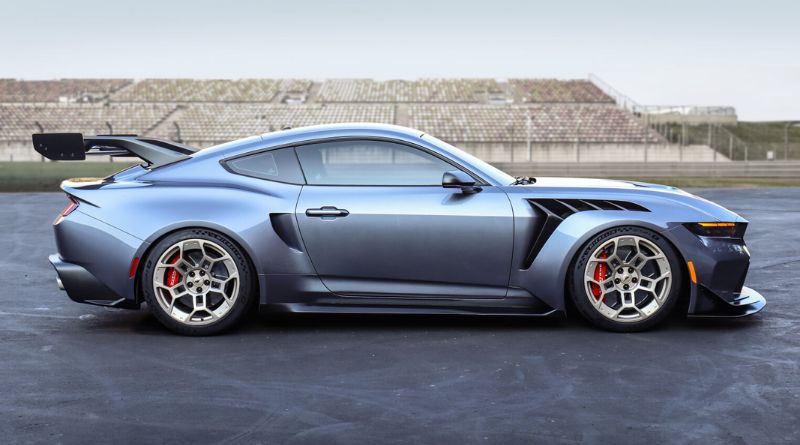
- 2025 Ford Mustang GTD. Street-legal, track-ready, and engineered to take on the Europeans, Ford’s newest monster of a Mustang boasts a custom-designed 800+ hp 5.2-liter supercharged V-8, unique semi-active suspension system, and a rumored sub-7-minute Nurburgring lap.
- 2024 Maserati MCXtrema. The Trident brought its own super sports car to Monterey. Derived from the MC-20 road car, the track-only beast will be powered by a 730-hp version of the Nettuno 3.0-liter V-6 and be limited to a mere 62 units – all of which are spoken for, and half of which are destined for U.S. buyers.
- 2024 Acura ZDX. While the pool of swoopy electric SUVs is growing a little crowded, we have to say Acura’s latest addition has our attention. But perhaps that’s because it’s essentially a clone of the Cadillac Lyriq? Built in partnership with GM, the Japanese brand’s first series-produced EV will ride on the Ultium battery platform and share its twin’s power output, range (roughly), and price tag. However, the ZDX’s interior is more conservative than the Lyriq’s, and its styling (in our opinion) a little more streamlined and consumer-friendly.
Looking to make a little noise? Presenting the new AWE Catback Exhaust Suite for the Honda FL5 Civic Type R, available now.

Here’s What Else You Need To Know This Week
While Monterey’s action dominates our coverage this week, there are several other interesting happenings in the auto world you should be aware of.
UAW Strike Seems Inevitable

United Auto Workers members have until this Thursday, August 24 to vote on whether or not their impassioned new leader, Shawn Fain, should authorize a strike against the Detroit Three automakers. With negotiations moving slowly and the companies showing little receptiveness to the UAW’s economic demands, the possibility of approval is very high.
High Stakes: According to a report by economic consulting firm AEG, a work stoppage would cause an economic loss of more than $5 billion after 10 days. Perhaps unsurprisingly, President Biden entered the fray last week, urging all sides to come to an agreement. The looming strike comes at a bad time for the administration, which is trying to both boost EV adoption and maintain Biden’s pro-union claims.
More Bad PR Threatens EV Growth

In more bad news for electric agendas, a recent J.D. Power study found a major drop in consumer satisfaction with both Level 2 and DC fast public charging stations across the United States – despite the increase in options and availability. The report called the beleaguered infrastructure “concerning” for automakers, noting EV owners’ biggest gripes were with charging times, location convenience, and equipment operability.
Gaining Momentum: Such news simply adds fuel to the motivational fire for those who argue the aggressive shift to EVs is misguided. Indeed, starting September 1, electric vehicle owners in Texas will be responsible for paying an additional $200 every year in state fees. Designed to make up for lost revenue from gasoline taxes, the fees will apply when a vehicle owner goes to register or renew registration. Texas lawmakers say the funds will go toward road construction and repairs across the state.
Self-Driving Snafu Just Days After SF Vote

In a matter of days since California regulators gave self-driving companies the go-ahead to operate 24/7 in San Francisco, things have gone strangely awry. One day after the vote, nearly a dozen Cruise robotaxis stalled and backed up traffic in North Beach — a result of “wireless connectivity issues” caused by increased cellphone use at the Outside Lands music festival, the company said. Then, a few days later, another Cruise robotaxi drove itself into a large patch of freshly-poured wet concrete. And just a few days after that, a Cruise vehicle drove into a firetruck that was en route to an emergency scene.
Actions Have Consequences: As a result of the “recent concerning incidents,” California regulators asked Cruise to immediately reduce its active fleet of vehicles by 50% until an investigation is complete. The GM self-driving subsidiary agreed to comply — but also defended the actions of its robotaxi.
In a blog post, Greg Dietrerich, Cruise’s general manager in San Francisco, claims the AV positively identified the emergency vehicle by sight and sound almost immediately. He blames the specific intersection, describing it as “significantly occluded by buildings” that make it difficult “for humans and AVs alike” to see objects until they are very physically close to them.
The Engine Block is your one-stop source for any and all auto industry news. Keep an eye on our weekly round-up of enthusiast coverage, product reviews, vehicle spotlights, auto show/expo features, and more. Check back Wednesday for a primer on upgrading your oiling system for track performance. Then, come back around on Friday for our monthly round-up of must-see automotive events.


