
Don’t Get Bent At The Line – Get Mandreled Instead
So you’re staging, and suddenly realize that your competitor is running a PYPES mandrel-bent exhaust versus your pressure-bent system. What do you do?
The best option will be to prepare for a graceful loss, since all things being equal, as soon as you put your foot down, you’ve accepted a horsepower loss of 3%-5%. Consequently, all the other driver has to do is avoid making a mistake as he/she runs to the end of the lane.
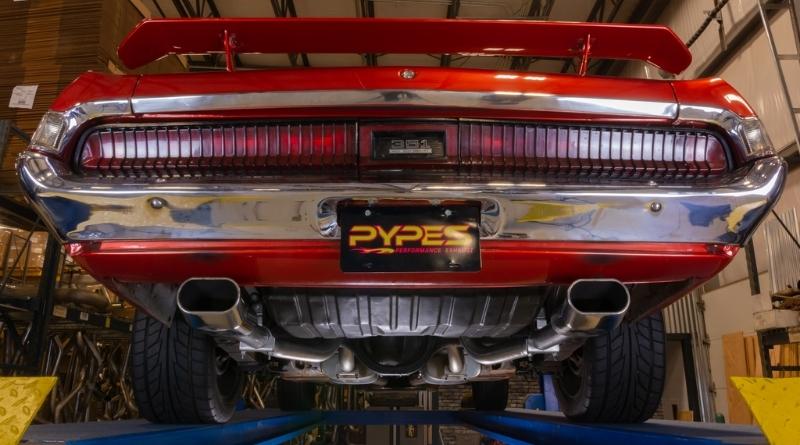
PYPES exhaust systems offer top-of-the-line products for the racer and the performance roadcar owner. The company’s mandrel-bent designs allow for maximum air-flow from the header flange all the way to the pipe tip.
Why Mandrel Is Better
If you’ve ever experienced the difference between a non-flexible straw versus one with a flexi-section at Dairy Queen, you immediately understand the value of the mandrel approach. In the former case, if you bend the straw, the flow of your milkshake is immediately constrained. Nothing will climb up through the straw because its diameter has been narrowed by a sharp bend.
On the other hand, if you’re using a straw with a flexible section, the diameter of its orifice maintains its shape throughout whether it’s bent or not. These results apply when bending metal as well. Although, in the case of exhaust piping, any narrowing of the pipe’s diameter can create a back pressure condition, subsequently creating a direct loss of power.
PYPES Power Proven On The Dyno
The value of the PYPES mandrel-bent approach is easily proven by horsepower numbers delivered during Dynamometer testing. In this case, a PYPES cat-back system was compared with two other branded exhaust systems associated with a 1994 Ford Mustang. Both maximum horsepower and torque have been clearly enhanced. (Dyno traces provides by PYPES.)

In a second instance, a stock 1985 Chevrolet Monte Carlo was put to the test. In this case, overall power was additionally constrained due to state emissions components. Nevertheless, even with these limitations applied, a significant change in power was exhibited.

Real World Builds
PYPES doesn’t just talk about the value of its products. It also puts its reputation on both the racetrack and the show floor by sponsoring and showcasing select race/performance teams in a host of classes and types of competition. Here are just a few of the company’s sponsored builds over the years.
Dan Woods

Dan Woods’ 1968 Ford Mustang Cobra is impressive right out of the box. The vehicle is a resto-mod that began its return to the track/show floor after being rescued in 1995.
The car’s restoration was finished in 1998 after finalizing the paint scheme, and Woods used it as a daily driver until 2008. At that point, he decided to show/race the car in 2010, after picking up 60 Show Awards. Its initial racing foray was for an episode of the TV Show Pinks!.
Subsequently, he ran the car in the 422 All Star Series in the Super Stock Class. During that time, he notched six top-10s in eight events. The car’s 428CI engine is quite stout since it mounts a Bullet roller cam and a modified Edelbrock manifold/head complex. The powerplant is also fitted out with Quick Fuel 850cfm carburetor.
The block’s strength is enhanced by decking, and it is line bored and cross bolted. It also uses a Scat crank, Mahley rods, and Diamond pistons. It has been fitted with a modified Ford C4 transmission, a Hartman aluminum drive shaft, and a Ford nine inch rear-end. All of this is, of course, rounded out by a PYPES cat-back exhaust system.
John Gaydosh Jr.

Gaydosh began his PDRA/NHRA Pro Stock career driving a Pontiac in 2007. By 2017, as his Gaydosh Performance team began to gel, he notched a first round NHRA win in Englishtown NJ, and then backed that performance up with a semi-round qualification.
In 2018, the re-branded Orange PYPES Chevrolet Camaro lost to Chris McGaha at that Gatornationals, in Gainesville Fla. Subsequently, he qualified for each remaining event of the 2018 Pro Stock season. In 2019, he sat out the year, along with the following season after selling his Camaro to an off-shore buyer. In 2021 he bought a brand new Pro Stock Camaro from Wally Stroupe.
It was originally built for another buyer, but the deal fell through. Consequently, Gaydosh was able to pick up the pristine piece just before the ’21 season. Its first outing was at Reading, PA in September of that year. After spending a considerable amount of time learning the new car, he was looking forward to the 2022 season when he injured his back moving equipment in the shop at Gaydosh Performance.
The injury not only sidelined him for the season, but his NHRA career as well. Since realizing the level of seriousness of the injury, Gaydosh has decided to content himself with running his own race team, utilizing Chris Sweeney in both NHRA and PRDA events.
Sam Hard

Sam Hard, a UK-based mechanic with a taste for American muscle, decided to build this wild 1936 Rolls Royce Rat Rod after attending the 2015 SEMA Show. Disappointed with all the shiny new builds, he set out to bring something wholly different to the following year’s show. And he delivered — along with a little help from his dad, Derek, as well as car-finder Michael Lightbourn and builder Jesse Gonzalez of Street Toys in Juarez, Mexico.
This rat rod project features an unpainted, polished aluminum body and 1970 Chevrolet Chevelle LS6 engine, with Pypes modified headers and electric cutouts. According to Hard and his builder mates, the power-to-weight ratio was on par with a Ferrari, and “it was quite scary to actually put your foot down.”
Hard sold the Rat Rod Rolls at the 2017 Mecum Denver Auction (something he now regrets) for $34,000.
Whether you’re an amateur hardcore racer, or just want your performance car to growl at car shows, PYPES systems fit the bill from front to back. These systems also match with most major muffler brands, so you’ll be sure to meet and exceed any road car requirement. PYPES make power, and at the end of the day, that’s what makes the exercise so fulfilling.


