
Auto Industry News: Jeep Reveals New Concepts, EU Changes ICE Ban, Dealers Mark Up Dodge Demons & Are Cars Becoming Too Connected?
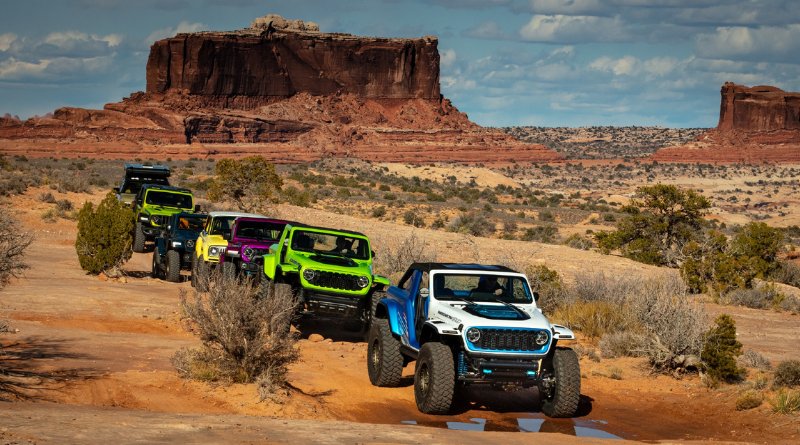
Jeep unveiled its official concept lineup for EJS in Moab, revealing seven new rigs – four of which use electrified power to crawl over rocks. Meanwhile, fellow Stellantis brand Dodge is dealing with consumer reports that dealerships are adding $50,000-$100,000 markups to the new Demon 170.
Across the pond, the EU spent last week revising its 2030 internal combustion ban due to push-back from Germany. And around the world, automakers are grappling with an alarming number of vehicle hacks and data breaches, begging the question: are cars becoming too connected these days?
Easter Jeep Safari Lineup Revealed, Hits Moab
The 57th annual Easter Jeep Safari kicked off Saturday, drawing thousands of off-roaders to the rugged trails of Moab, Utah. After a drawn-out teaser ad campaign, title sponsor Jeep finally pulled the covers off its new debuts. They include seven one-of-a-kind new concepts, four of which bring electrified power to the dusty desert.
Electric Off-Roading

Among the electric and hybrid models is the third iteration of the Jeep Wrangler Magneto concept – the first battery-electric vehicle (BEV) concept from the Jeep brand. Magneto 3.0 pushes the performance envelope, sporting a new and more efficient motor that boosts torque output to an incredible 900 lb.-ft. Updated programming ensures a 20% increase in useable energy and range, while three driver selectable functions capitalize on the benefits of a fully electric powertrain in serious off-road situations.
Jeep’s other electrified concepts include:
- a resto-mod 1978 Jeep Cherokee 4xe Concept that pays homage to the newly-discontinued nameplate;
- a head-turning magenta-colored Jeep Wrangler Rubicon 4xe Concept;
- and a Jeep Wrangler Rubicon 4xe Departure Concept that really plays up the brand’s open-air cockpit and functions like a rolling catalog for Jeep Performance Parts (JPP).

Traditional Oomph
As for the ICE-powered concepts, Jeep proves it still knows how to do the biz even with a looming EV agenda.
Three builds hit the desert, the most exciting of which is no doubt the Jeep Scrambler 392 Concept. A nod to the brand’s first convertible, compact truck, the concept started life as a four-door Jeep Wrangler Rubicon and features a 470-hp 6.4L HEMI V-8, custom carbon-fiber bodywork, adjustable AccuAir air suspension kit, and a modified silhouette that gives a nod to chopped top hotrods.

The brand’s other two gas-sipping models include:
- a Grand Wagoneer Overland Concept that leverages the all-new 3.0-liter Hurricane Twin Turbo 510 engine to deliver premium performance in premium digs;
- and an accessory-happy Jeep Gladiator Rubicon Sideburn Concept equipped with a 3.6-liter Pentastar V-6 engine and plenty of new off-road goodies like a sport bar with built-in bed steps and a custom-designed tubular grille guard that folds down into an innovative bumper bench.

Did you know…?
Truck parts and accessory manufacturer RealTruck (formerly Truck Hero) is launching its own apparel line. The collection includes tees, hoodies and headwear, as well as an assortment of custom graphic stickers, all designed for outdoor, off-road and truck enthusiasts. The new line will be available for purchase at Easter Jeep Safari during the last two days of the event.
Dealer Markups on Challenger Demon 170 Surpass $100k
Two weeks ago, Dodge revealed its final Last Call tribute model – an absolutely bonkers, ethanol-fueled Challenger SRT Demon 170 that makes 1,025 horsepower and zooms 0-60 in a mere 1.66 seconds. Dodge also attached a bargain price tag to all that power: $99,666 MSRP.
Unfortunately, a limited-edition run vehicle combined with rabid customers and a few greedy dealers makes for a markup trifecta – and reports are rolling in of Dodge’s last V-8 muscle car regularly selling for $50,000 over asking price. Some dealers are even bidding off allocations at $200,000-$250,000 over MSRP.

The insane markups aren’t exactly a surprise. After all, Chevy endured a similar issue with its C8 Corvette Z06, prompting the automaker to cancel warranties on vehicles resold within six months of purchase. However, short of a few empty threats to take away allocations, dealers guilty of hefty markups received no reprimand.
A similar story seems to be playing out in Dodge’s dealer network. Though, in the automaker’s defense, it did make a (feeble) attempt to get ahead of the problem by prioritizing the vehicles that are sold at MSRP.
“Our goal is to make 3,000 cars for the U.S. market,” CEO Tim Kuniskis told Jalopnik. “I don’t know if we will be able to accomplish that, but that’s the goal. We will build the MSRP cars first, and those that paid over MSRP may risk not getting a car.”
Dealers are required to submit notarized documents indicating whether or not a customer’s Demon 170 sold at or above MSRP. Kuniskis claims that of the 1,000 documented orders already confirmed, 62% are at MSRP.
With 1,500 cars left to sell, however, we have to wonder if that percentage will hold. Being ‘pushed to the back of the production line’ feels like a pretty hollow threat.

EU Changes 2035 Combustion Engine Ban
Late last year, the European Union announced it would enact a total ban on the sale of new diesel and gasoline cars by 2035. Lawmakers were preparing to vote the ban into law last month when suddenly, Germany pushed back. The automotive-rich nation argued that vehicles running on synthetic e-fuels should be granted an exemption.
Synthetic fuels are created using renewable energy, but still produce emissions when burned. They garner their “green” labeling from the fact that their manufacturing process, in essence, “cancels out” their CO2 production.
Environmentalists and EU lawmakers argue that e-fuels are still dirty, and therefore jeopardize the very climate targets that led to this ban being enacted. (Indeed, the decision resulted from a climate-change law adopted in 2021 that legally requires all 27 countries in the EU to have 55% less CO2 emissions by 2030 and zero CO2 emissions by 2050.) They also point out the limited supply of these synthetic fuels, due to complex and costly manufacturing processes, and believe they would be better served as alternative options to industries that are more heavily dependent on fossil fuels, like aviation and shipping.
Despite the grumbling, however, EU leaders conceded to Germany’s demands. The 2023 ban will exempt vehicles that run exclusively on synthetic e-fuels, though vehicles will be required to have technology that prevents operation if another fuel is used.

Are Cars Too Connected?
Connected technologies play a critical role in today’s vehicles – not just in the ways they are driven (ADAS sensors, over-the-air updates, onboard AI assistants) but also in the ways they are manufactured and sold (online ordering, digital recall fixes, subscription services).
That translates to a lot of data being passed around. And while automakers and third-party providers spend big bucks on developing these new technologies, research shows they spend considerably less money on shoring up their digital defenses.
In early March, Automotive News reported that automakers might employ security specialists to identify vulnerabilities and breaches, but they are paying them a fraction of what other industries do, like telecoms, crypto and retail. Even the government pays these “white hat” hackers more money.

Israeli cybersecurity firm Upstream notes in its 2023 global cybersecurity report that the number of automotive API attacks increased by 380% from 2021 to 2022. While the report includes those incidents carried out by “ethical” hackers to find issues, it stresses that 63% were performed by cybercriminals who attacked these systems for personal gain or malicious purposes.
For reference, API stands for “application programming interface” and basically refers to the software or mechanism that allows two apps to talk to each other and share information. Think of it like a digital bridge of sorts between two pieces of software. When you order an Uber for the ride home or you Venmo your friend $20, you’re using an API.
Why is this topic in the news again?
Just last week, two security researchers explained how they were able to hack a Tesla Model 3 in less than two minutes.
By breaching the car’s infotainment system, they could unlock the vehicle’s doors and trunk, change seat positions, and even adjust steering and acceleration modes. What’s more, they accomplished all this by hacking into Tesla’s wireless network from a drone.

The researchers performed the hack as part of a competition, which netted them $350,000 and, ironically, a new Tesla Model 3.
Thankfully, this incident had no malicious intent. However, the larger ramifications are still scary and shine light on a fast-growing issue in the automotive industry – especially as these attacks grow more sophisticated. According to Accenture, the automotive industry will lose $505 billion to cybercrime between 2019-2023.
So, what can you do to protect yourself?
First things first, be smart about what you do online. Limit what you share with strangers – even in your favorite groups and forums. Also, use unique passwords and try to keep online purchases to one credit card so you can more easily review the bill when it comes in.
For car enthusiasts in particular, stay away from any free software that promises to ‘jailbreak’ vehicle diagnostics like unlocking engine tuning or premium features. That’s a great way to expose yourself to malware, spyware, and/or ransomware. Adding two-factor authentication for certain in-vehicle apps is a good idea too, since it makes it harder for hackers to get into your account (and your vehicle). And, if your vehicle has on-board Wi-Fi, change the password often and make sure it’s not something easy to guess.
Lastly, don’t be afraid to ask tough questions of your car dealer. How do they protect your data during and after the buying process? In 2023, they should be able to answer these questions quickly and confidently.

The Engine Block is your one-stop source for any and all auto industry news. Keep an eye on our weekly round-up of enthusiast coverage, product reviews, vehicle spotlights, auto show/expo features, and more. Be sure to check back Wednesday for a guide on fuel system maintenance and Friday for some tips on how to make that old truck feel like new.


