
Auto Industry News: Toyota Shuts Down, Ford Cuts Escape, & Feds Focus on Tesla (Again)
Toyota found itself grappling with a software update gone wrong last week, leading to a very expensive, full-day shutdown of 14 Japanese plants. Meanwhile, Tesla’s Autopilot software is back under the federal microscope, this time for a supposed hidden feature that creates a dangerous safety workaround. Over at Ford, we saw bold moves. The Blue Oval is bidding farewell to three ICE models, including the beloved Escape crossover, as it accelerates towards an electric future.
The Engine Block has everything you need to know, plus quick-hit updates on UAW contract negotiations, a potential new street-performance F-150, and the upcoming Ferrari movie.
Toyota’s Exceptionally Expensive Software Glitch

It’s one thing when your personal laptop restarts with a Blue Screen of Death; it’s a whole other can of worms when an entire automaker’s production line experiences such a glitch.
Unfortunately, that was the case at Toyota last week when a routine software update shut down a core computer system. The glitch – if it can be called something so mundane – led the automaker to shut down operations of all 28 vehicle assembly lines at its 14 Japanese plants. While the factories were back online the next day, the one-day stoppage is estimated to have cost nearly $356 million in lost revenue.
Toyota did not provide details of what exactly went wrong during the update, but did note that it was not the result of a cyberattack. (In February 2022, the automaker ceased production at the same plants when its electronics and plastic parts supplier, Kojima, was infected with a virus.)

The malfunction specifically affected Toyota’s ability to process orders for vehicle parts. Since the automaker uses (and indeed, is responsible for pioneering) a just-in-time method of inventory management, you can imagine what kind of effect the inability to procure necessary components has on the larger supply chain.
Toyota’s no good, very bad day of lost production comes at a particularly aggravating time for the automaker. The company just reported a successful rebound from COVID-induced semiconductor shortages. In fact, Toyota’s global and overseas production both reached record highs in July 2023 as a result of improved production capacity, and global sales numbers jumped 8% YoY to a record 859,506 vehicles.
Tesla Under Close Federal Scrutiny… Yet Again

In what is starting to become a tired opening line in automotive news, EV maker Tesla finds itself in the federal hot seat – again. The most recent round of increased scrutiny comes from NHTSA and concerns the company’s Autopilot system.
Already under investigation for false advertising and faulty technology potentially leading to death, the driver assistance software is now being looked at amid allegations of a secret feature that allows users to engage the system without the associated “nags” reminding them to keep their hands on the steering wheel. The workaround, dubbed “Elon Mode” by the Tesla hacker (@greentheonly) who discovered it, is thought to be a company-car-only feature intended for executive testing.
NHTSA’s not taking chances however, and expressed concern that the feature may be in consumer vehicles too. “Now that the existence of this feature is known to the public, more drivers may attempt to activate it,” the agency wrote in a special order to Tesla demanding extensive data on the software.
Impressions after nearly 600 miles on 11.4.3 with Elon mode (could not get a non-Tesla car to try in time).
It went much better than the prior experiment obviously.
Many contributing factors. I was not as late so I did not mind as much (still ended up 5 minutes late solely— green (@greentheonly) June 17, 2023
Safety regulators stressed that the resulting “relaxation of controls” — which are specifically designed to keep drivers engaged in the dynamic task of driving — could lead to greater driver inattention and ultimately, failure to properly supervise the Autopilot system.
The order, dated July 26, gave Tesla one month to respond. According to NHTSA, the automaker answered on time and was granted a request for confidential treatment – meaning no public version of the response is available.

Did you know…?
As NHTSA demands more information on Tesla’s advanced driver assistance systems out of misuse concerns, it seems that overall electric vehicle consumers are demanding even more technology in their rides.
According to the J.D. Power 2023 U.S. Tech Experience Index (TXI) Study, EV owners particularly like Plug & Charge capability, which allows them to pay for charging without using a payment card or app. However, they find biometric technologies like fingerprint reading, facial recognition, and eye movement trackers to be both annoying and “not useful” – bad news for safety regulators who see many of these features as instrumental to monitoring the use of driver-assistance tech.
Ford Cuts Three Models – Including Popular Escape – For EVs

Despite admitting a difficult EV transition – one poised to cost the company $4.5 billion this year – Ford is funneling big investments into a second-generation electric platform set to underpin several new models. It’s also taking the ax to three familiar nameplates: the Edge, Escape, and Transit Connect.
While news of the smallest gas-powered van’s demise has been known for at least a year, the end of the Edge and Escape models admittedly comes as a surprise. Sales were down last year, but both models still remain among Ford’s more popular sellers – the Escape in particular.
According to Automotive News, the Transit Connect will live on in Europe but exits the U.S. market after the 2023 model. The Edge will make it until next year, at which point Ford plans to have its assembly plant converted to an EV facility.

As for the Escape, that model saw a slight refresh this year, so will likely last until 2025 before an EV crossover knocks it out of the lineup. The publication also noted that Ford currently has no plans for a hybrid model, an interesting development since CEO Jim Farley recently said the company plans to quadruple its hybrid sales in the next five years.
On the bright side, we may be getting another Ford pickup.
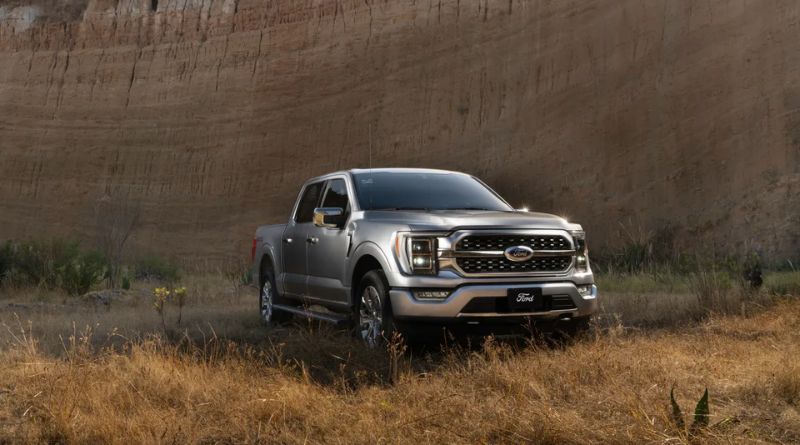
Ford Authority first reported last week that a street-performance model called the Lobo will join the F-150 lineup. According to unnamed sources, the Lobo will be its own trim, boasting a lowered ride height and “sinister and aggressive” appearance.
The name, which is still used in Mexico, translates to “wolf” and was filed for trademark on August 14. Interestingly, that same day, the automaker also submitted an application to trademark the name Maverick Lobo. The 2024 Ford F-150 will debut later this month at the Detroit Auto Show, so here’s hoping more details on the street trim will spill out then as well.

In Case You Missed It…
Four years after Hollywood magic showed how Ford built a car to beat Ferrari, the prancing horse is set to receive its own cinematic treatment. The first action-packed teaser trailer dropped last week for Michael Mann’s upcoming Ferrari.
Starring Adam Driver, Penelope Cruz, and Patrick Dempsey, the film follows ex-racer Enzo Ferrari during the summer of 1957 as he struggles with a volatile marriage, grief over the death of his son, and the threat of bankruptcy, all while pushing his drivers to compete in the treacherous 1,000-mile race across Italy, the Mille Miglia. Check out the trailer below.

What Else You Need To Know This Week
- UAW members rejected Ford’s recent contract proposal, which included a 9% raise offer, saying it did not go far enough to address key union concerns like wage tiers and profit sharing. The union leader also accused General Motors and Stellantis of unfair labor practices, going so far as to file charges with the National Labor Relations Board. He alleges the automakers are refusing to bargain in good faith during contract negotiations.
- On Thursday, the Biden administration announced it will hand out $12 billion in subsidies to help automakers retool their factories for electric vehicle production. Since much of the money will land in Detroit automakers’ accounts, it could presumably free up funds for meeting UAW demands.
- A new study by the Highway Loss Data Institute revealed its list of the most-stolen vehicles for model years 2020-2022 and a familiar face topped the charts again: the Dodge Charger. Theft claims for the Charger SRT Hellcat were more than 60x (!) more frequent than the average for all other models, relative to their numbers on the road. Meanwhile, theft claims for the Charger HEMI were more than 20x higher than average. “If you own a Hellcat, you better check your driveway,” said HLDI Senior Vice President Matt Moore. “These numbers are unbelievable.”
The Engine Block is your one-stop source for any and all auto industry news. Keep an eye on our weekly round-up of enthusiast coverage, product reviews, vehicle spotlights, auto show/expo features, and more. Check back Wednesday for a rundown on choosing the correct automotive grease, and then circle back on Friday for a primer on how to take picture-perfect snaps of your vehicle.


